Articles from and news about the premier and longest-running academic journal devoted to all aspects of cartooning and comics -- the International Journal of Comic Art (ISSN 1531-6793) published and edited by John Lent.

Saturday, December 27, 2025

Graphic Novel Review: Cat Mask Boy by Linus Liu

 Reviewed by Joe Hilliard

Cat Mask Boy by Linus Liu, Nakama Press, 2025. 192 pages. $10.99 paperback. https://www.simonandschuster.com/books/Cat-Mask-Boy/Linus-Liu/9781545821732

"For every superhero, there's a monster. For every lazy student, there's homework." (13) So begins the journey of Tiger in Linus Liu's Cat Mask Boy. Set in early-70s Hong Kong, Tiger is a lackadaisical student, preferring to dream of a life of superhero than concentrate on his grades or working hard for the future. Well, that's not exactly true, Tiger is working hard for a future of fighting crime. Liu never shows us Tiger's "human" face. The preface shows Tiger from the back tossing a paper airplane off a building. Going forward, we only see him wearing his cat mask. Tiger is Cat Mask Boy!

Tiger just doesn't just fight for justice though. He fights a society that only cares for performance, for results. For grades. Even in second grade, Tiger's world is obsessed with the best in class, getting good grades, and how this defines life. Moms beat children for poor grades. His friends constantly worry about the future, what their grades are going to be. Perhaps this is early-70s Hong Kong, or perhaps it speaks to the constant struggle we see:  performance versus being real. Being true to yourself. The struggle we see today.  Every day. "I promise I'll still be a decent person even if my grades are poor." (133) The push and pull of Tiger versus Cat Mask Boy.

It all comes to a head for Tiger on report card day. Through a series of events that would only happen in a comic book world, Tiger loses his report card, which needs to be signed by his mom and returned to school. A lost report card which sends Tiger on a quest into the walled Kowloon City. From this juncture, a traditional hero’s journey quest does permeate the top level of the book, as Tiger moves through dangerous situations rife with gangsters, violence, loss, as he searches for the elusive report card. It's here. It's gone. It's there. It's here again. It's found and discarded, lost and not needed. All at once. Beyond this physical journey though, Tiger fundamentally chases the meaning of life as well. What it means to live well. To live meaningfully.

Liu cleverly uses the cultural touchstone of the Japanese tokusatsu television show Kamen Rider throughout, which proves an interesting counterpoint to Tiger. For those who came in late, as Lee Falk would put it, the original Kamen Rider ran from 1971-1973 and featured the namesake character, a cyborg man-grasshopper hybrid created by the villainous organization Shocker to be their agent, but who has escaped their brainwashing and now fights against them. While none of this background is dropped into Tiger's story, this context adds another layer. Who has created Cat Mask Boy? What has created Cat Mask Boy? Is he escaping societal brainwashing? Tiger needs to find what makes a hero. The true goal. "School teaches us to be a good person, but never teaches us how to protect ourselves from bad people." (154) Initially, the image of the Kamen Rider is used as a foil, as Tiger's schoolmates berate him for not being a real hero like the Rider, leading to trouble in school.

When he meets Dragon, a fellow masked boy in Kowloon, they mimic the arm motions of the Rider to each other, signifying first their bond as fellow superheroes. Later, as they work together, and Tiger sees Dragon as an embodiment of heroism, they repeat the action, this second time as friends. It's a neat piece understanding how pop culture helps create friendships. How we bond over the simplest things. As an 80s teen, buying Justice League International off the shelves, my friend and I would call ourselves Blue Butthead and Buster Gold. And mimic Giant Robot's hand signs. It's simple. It's real. And Liu taps into that.

Beyond that simple pop artifice though, Liu delves deeper with Dragon. "Even if I have tons of toys, would I be happy if there's no one to play with?" (103) Dragon understands something that Tiger does not yet. That Cat Mask Boy does not yet. This is the journey that Tiger must travel through Kowloon, and then ultimately out of the walled city. Out of his walled self. The acceptance of true friendship, true relationship. Dragon's selflessness counterpoints Tiger's selfishness.

Artistically, Liu has a beautiful clean line style more reminiscent of Los Bros Hernandez or Adrian Tomine than of manhua. It works perfectly to express the stylized Kowloon of the book – where kids wear animal masks with no question. The use of only a three color palette over the panels, accentuating the action, gives the book the feel of a 70s comic book, where the colors are perhaps bolder and off-kilter, and yet still modernized to give counterpoint to the panel work and dialogue. It reminds of J. Gonzo's use of color and paper effects in La Mano del Destino. Down to the texture of the paper. Even in eBook form, Lu captures the rag texture of paper, real paper, on each page. Manifesting as a book, an artefact, a journey. And neatly complementing the 70s feel of the story. The only ruining effect is the font used by Book Buddy Media for the English translation caption boxes and dialogue. Darker black and baldly nondescript, it gives the impression of having been typed in later on a copy and not really integrated into the book. It's a strange, and distracting, look.

"The report card reflects only schoolwork. Personal growth is based on life experience." (147) Tiger earns his life experience. He learns his freedom. He completes his hero’s journey. More than that, he affirms that life is more than simply school, work, more than the expectations and demands of society.

"My mom told me getting good grades means a can earn a lot of money from work." – "Just some comic book dialogue, which I don't think you've read." (125)  To which, always read the comic book dialogue. And always read between the lines. Read Cat Mask Boy.

 A version of this review will appear in IJOCA 27-2. 

Wednesday, December 24, 2025

Book Review: On Black Bandes Dessinées and Transcolonial Power

 reviewed by John A. Lent, International Journal of Comic Art

Michelle Bumatay. On Black Bandes Dessinées and Transcolonial Power. Columbus:  The Ohio State University Press, 2025. 155 pp. US $36.95 (Paperback). ISBN:  978-0-8142-5937-5. https://ohiostatepress.org/books/titles/9780814215821.html

 Any time a new book appears that concentrates on a large segment of Africa and its comics art, celebration is in order, for the pickings have been slim. Anthologies of a particular cartoonist’s work, such as that of Zapiro, Barly Baruti, Marguerite Abouet, Gado, and other masters, are more readily available, as are biographical treatises and analytical monographs on specific characters. However, few continental or regional overviews exist.

So, a hearty welcome to Michelle Bumatay’s On Black Bandes Dessinées and Transcolonial Power, that consists of four chapters that analyze the works of Francophile West and West Central African cartoonists, from the Congo, Ivory Coast, and Cameroon.

The author sets the parameters of her study as being built around “key moments, artists and authors, themes, and publications” of Black bandes dessinées, which include, “political and editorial cartoons, serial publications and self-published magazines, anthologies, mainstream and independent albums, blogs, digital comics, and mobile apps” (15). Though the methodology of the work is missing, it seems to be a qualitative textual analysis with a small mixture of biographical analysis. Bumatay emphasizes the key role that the Franco-Belgian colonial heritage and ongoing imperialism have played on the development of Black bandes dessinées, as well as their effects on the artists, cautioning that the artist’s work varies from “individual to individual and from one project to another” (130), and that attention must be paid to context.

Notions about important West/West-Central African traits and issues are systematically analyzed/argued by Bumatay--that self-fashioning is a “crucial component” of Black cultures, exemplified in her case study of Kinshasa from the late 1960s to the 1990s; how Abouet markets her comics through the postcolonial exotic, and how she pushes for a “new inclusive understanding of universalism that demands a reworking of notions of gender, race, and power” (130); how Black bandes dessinées, for decades, have decried borderization’s (Northern migration) ruinous impacts, raising levels of brutalization, suffering, and indifference, and how these cartoonists have fashioned their styles to become “symbolic forms of restitution” of the world’s environment.

What Bumatay has achieved here is praiseworthy--giving her interpretations of the works of some African bandes dessinées cartoonists, supported by close readings of their works and backed up by similar notions and ideas of a host of researchers from different fields. That was her intention, well and good.

But, let me go off on a tangent--in no way, to devalue the merits of the author’s work--, and ask, are these interpretations aligned with what the artists intended? We don’t know unless journalists and researchers ask them, and, in this book, there does not appear to be evidence that any interviews that may have been done with the artists were used. It would not have been an onerous task for Bumatay to search for interviews in this high-tech age, and, if none is available, which is very unlikely, she could have conducted the interviews herself. Granted that interviewing was not a part of her research plan, so, maybe it can be a major part of her next research project.

The four artists discussed at length in On Black Bandes Dessinées… are still alive, active, and likely accessible. Barly Baruti (born 1959, in the Congo) has lived in Belgium since 1992; Marguerite Abouet (b. 1971, in Ivory Coast) resides in Romainville, France; Papa Mfumu’Eto 1er (b. 1963) is still in Kinshasa, Congo, and Japhet Miagotar most probably is still around, having been interviewed as recent as 2019. To make matters even easier should Bumatay choose to pursue a topic of this nature, much of the original art of Mfumu is being archived at the University of Florida, not far from where she is an assistant professor, Florida State University.

A suggestion for a future research project for an author whose book is being reviewed may seem to be out of place, and, it may be, but it was made with good intentions, one of which was to get my point across any way I could, that interviewing cartoonists while they are still with us is extremely important for comics scholarship. Okay, point made. Sorry, Ms. Bumatay, for the interruption.

To wrap up, On Black Bandes Dessinées and Transcolonial Power is a valuable contribution to comics scholarship, because it enlightens about cartooning in a part of the world where comics art research is sadly scarce; hones in on a few distinguished cartoonists, allowing for in-depth analysis; for the most part, soundly makes and defends its many arguing points, and employs a rich mixture of secondary sources.


Tuesday, December 23, 2025

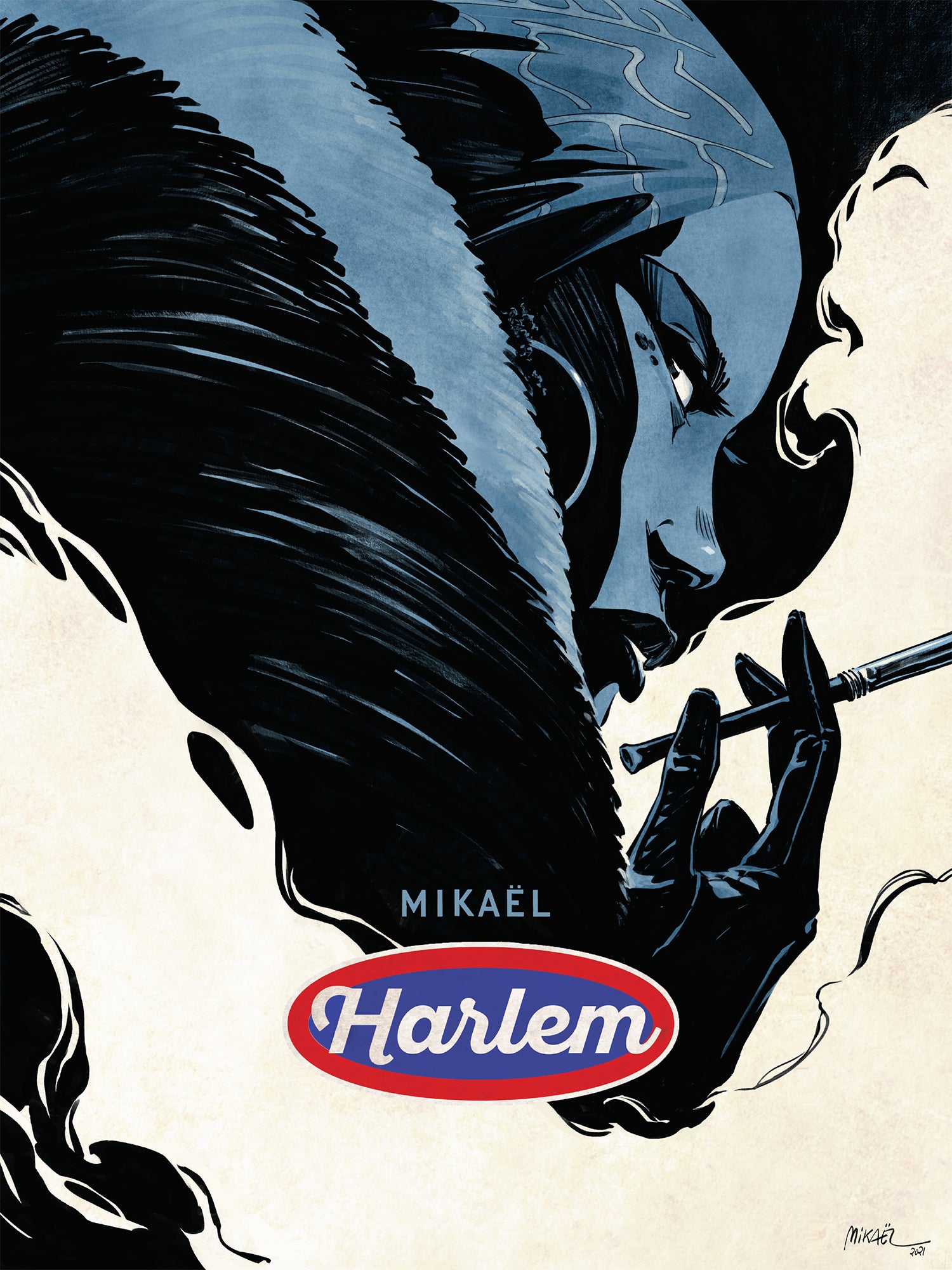
Graphic Novel Review: Harlem by Mikaël

 Harlem

 reviewed by Matthew Teutsch, Associate Professor of English, Piedmont University

Mikaël. Harlem. New York: NBM Graphic Novels, 2024. https://nbmpub.com/products/harlem


French-Canadian artist Mikaël concludes his New York triptych with Harlem, a fictionalized narrative about Stephanie St. Clair, a woman from Guadalupe who became a businesswoman and racketeer in Harlem during the early part of the twentieth century and the Harlem Renaissance. The narrative moves back and forth in time, detailing St. Clair’s life in Guadalupe to 1930s Harlem. When depicting St. Clair’s early life and eventual immigration to the United States, Mikaël’s color palette changes from more browns and darker colors to shades of purple with splashes of yellow. The yellow, which appears in various objects during these flashbacks from a parakeet to a bag to a light in a window, displays St. Clair’s hope and the hope of others for a better life, one where they can live their lives in happiness and safety.    

While on the surface Harlem appears to be a crime narrative centered on St. Clair, Mikaël infuses his story with much more. Mikaël highlights the ways that St. Clair and others navigate, through extra-legal means, a system that keeps them oppressed and subjugated from the highest levels of city government to the police force that walks the streets to other racketeers, notably Dutch Schultz (a white man), who also participates in extra-legal activities. Along with all of this, the community must deal with the ramifications of the Great Depression on their lives. Even as she maintains a hard exterior, St. Clair looks out for the community, providing individuals with hope and resistance, specifically through the pieces that she writes in the New York Amsterdam News calling out systemic oppression.

Ostensibly, the white reporter Robert Bishop serves as the overarching narrator of Harlem, opening the narrative by telling us, “What I did was unforgivable. I know.” By framing the narrative through Bishop, Mikaël allows us an outside view of events. The reader does move into St. Clair’s perspective and the perspectives of others, but Bishop remains the core, and in this manner, he serves, in many ways, like the “white clientele” who flock to Harlem for the clubs and nightlife that Harlem’s residents are barred from entry. Bishop has a relationship with Tillie Douglas, one of St. Clair’s friends, and their interactions highlight the ways that white supremacy did not solely reside within the Jim Crow South or the once colonial regions of the Americas. 

Bishop’s connection to St. Clair arises after the editor of the New York Amsterdam News tells her she needs to revise a piece that she hopes to get published in the paper. St. Clair sees Bishop with Douglas and enlists him to help her revise the piece, which he does. In her article, St. Clair lays out what she and the community endure in the face of white supremacy. Over three pages, Mikaël prints St. Clair’s article interspersed with images of individuals getting kicked out of their homes, police brutality, and cultural tourism with whites descending on Harlem for clubs. The sequence ends with the reactions to her piece from Schultz, the police, and her right-hand-man Bumpy. Thematically, this three-page sequence sums up Harlem and the ways that St. Clair pushed back against a system that seeks to keep her and other locked in cages as they bloody their wings against the iron bars.

In “Sympathy,” Paul Laurence Dunbar uses the metaphor of a caged bird beating its wings until “its blood is red on the cruel bars” to describe his position as a Black man at the turn of the twentieth century in America. He concludes the poem with the famous line, “I know why the caged bird sings!” The caged bird metaphor appears throughout Harlem, from St. Clair releasing a bird from a cage in Model’s shop to numerous panels depicting birds flying as St. Clair and others walk the Harlem streets. Harlem concludes with St. Clair returning to the community as residents thank her for speaking in front of the commission and her actions, and the final two panels show birds flying freely in the sky. The first shows birds flying up into the air as we see buildings and a street sign for 125th street. The final panel zooms out, showing the entire New York skyline with flocks of birds in the distance, symbolizing St. Clair’s and the residents’ desire to, as St. Clair tells W.E.B. Du Bois earlier, that she will not “shut [herself] between four walls.”  

If one reads Harlem quickly, one will miss many of the historical and cultural references that Mikaël incorporates throughout the book. For example, in a seven-panel sequence following a numbers runner, we see the marquee for Smalls Paradise, one of the only African-American owned clubs in Harlem at the time, and a panel depicting young kids marching with brooms and paper hats imitating the Harlem Hellfighters as a World War I veteran sits on the side. Mikaël also incorporates two poems by Langston Hughes, one at the end of each section. Hughes’ “Harlem” concludes section one, and Hughes’ repetition, in the first and third stanzas of referring to Harlem as “on the edge of hell” drives home what St. Clair fights against. Juxtaposed against “Harlem,” Mikaël ends the book with Hughes’ “I, Too,” where Hughes proclaims his equality and finishes by stating, “I, too, am America.”

Mikaël ‘s Harlem details the history of white supremacy in the United States, colonialism, sexism, and structural issues that impact Harlem and its citizens. It also highlights community and the ideals of America, specifically the immigrant experience and the ways that communities work together to confront oppression and move forward. Through Bishop, Mikaël explores allyship and the need for white individuals like Bishop to listen instead of speaking at times. Bishop gets St. Clair arrested, and as she leaves prison, we see Bishop’s words to her as he types them. He tells her when he envisions her in his mind he sees “[a] look of anger. The anger of an entire people,” and he concludes by telling her, “I only wanted to speak out about the world around me because I thought I had the right to.” Bishop’s words end, allowing St. Clair a voice for herself at the end, a voice that speaks for Harlem.     

 A version of this review will appear in IJOCA 27-2