Articles from and news about the premier and longest-running academic journal devoted to all aspects of cartooning and comics -- the International Journal of Comic Art (ISSN 1531-6793) published and edited by John Lent.

Showing posts with label music. Show all posts

Saturday, December 27, 2025

Graphic Novel Review - Interficial ARTelligence: The Moments That Met Me by Chuck D

Reviewed by Joe Hilliard

Interficial ARTelligence: The Moments That Met Me, by Chuck D., Akashic Books 2025. 240 pages. $24.95 paperback. https://www.akashicbooks.com/catalog/interficial-artelligence/

While Chuck D is known as a founder and front man for the rap group Public Enemy and his outspoken politics, he also has a burgeoning career as a graphic novelist. His previous graphic novels, the three-volume Stewdio: The Naphic Grovel Artrilogy and The Summer of Hamn: Hollowpointlessness Aiding Mass Nihilism, were modern history/political theory treatises. With his newest 2025 book though, he has turned overtly autobiographical, streaked through with social and political commentary, much like a Public Enemy album.

Unlike a traditional chronological autobiography, Chuck D slings together a collage of images and time slips, much like old-school rap where the cut up of words, images, feelings, all intertwine, entangling. Functionally, Interficial is a collection of two-page spreads of reminiscences, in no particular order, of people he has met. Not simply a greatest hits collection, but the subtle hints, deep cut grooves following from the big notes we all know. The grandiose to the sublime. Mixing and matching, scratching the beat, page to page to page. Vignettes of the big moments and the small, on the stage, sharing a drink in a car, changing tires. Short meetings with the famous. From the ‘80s to his New York youth to the present, and yes, looking to the future, for those he still wishes to meet.

Some of the art is scribbled and ragged. Lines show through, as he has not erased the original preliminary sketches. He uses markers and colored pencils over his pencils. It's his notebook, copied out, the colors bleeding through page to page. There is a fierce spontaneity to the work. It has a certain rough-hewed Bill Sienkiewicz circa Big Numbers feel. Or like what John Jennings is currently producing. With that rawness. More ragged. Like a live performance caught in media res. It's Sam Cooke's Live at the Harlem Square Club, 1963 and not the singles that are on the radio and streaming. Throaty and raw. Each spread is a person that Chuck D has spent time with. "The moments that met me." While the art does not fall into caricature, eschewing the obvious, on the opposite spectrum, some of the sketched faces are not immediately recognizable, even while reading the text. But others are amazing in their true to life feel. Snapshots. Dick Gregory massaging Chuck D's feet. Debbie Harry in disguise, looking like Natasha from Bullwinkle. Teenage Keith Shocklee changing tires at Sears. It's the vibrancy that works so well, the immediacy. Warren Beatty working on Bulworth, the crackle of looking in from the outside into old Hollywood.

Unfortunately, some of the writing is hard to follow, falling around the margins and tumbling around the images. Circling over the drawings and enveloping them. This is particularly a product of the notebook form. Words scribbled on drawings. Rushing out in a notebook stream. A bigger issue, speaking to the production itself, is the tight paperback spine that obscures the center of each of the two-page spreads, especially as you get closer to the center of the book. The words and art sink into themselves, obscuring words and images. It's very frustrating.

Even with these faults, Interficial is compelling in short bursts. The non-linear approach lets you delve in with fits and starts. Opening at random and being surprised. Seeing the relevance to today as Chuck D's social concerns hums, lecturing with Angela Davis, lobbying in Washington DC with Anita Baker, his wish to meet Barack Obama. If it were larger format, it could easily be a coffee table book to be read over and over again. It's not perfect, but it engages. Which is what Chuck D wants. And what you expect, and want too.

Friday, June 13, 2025

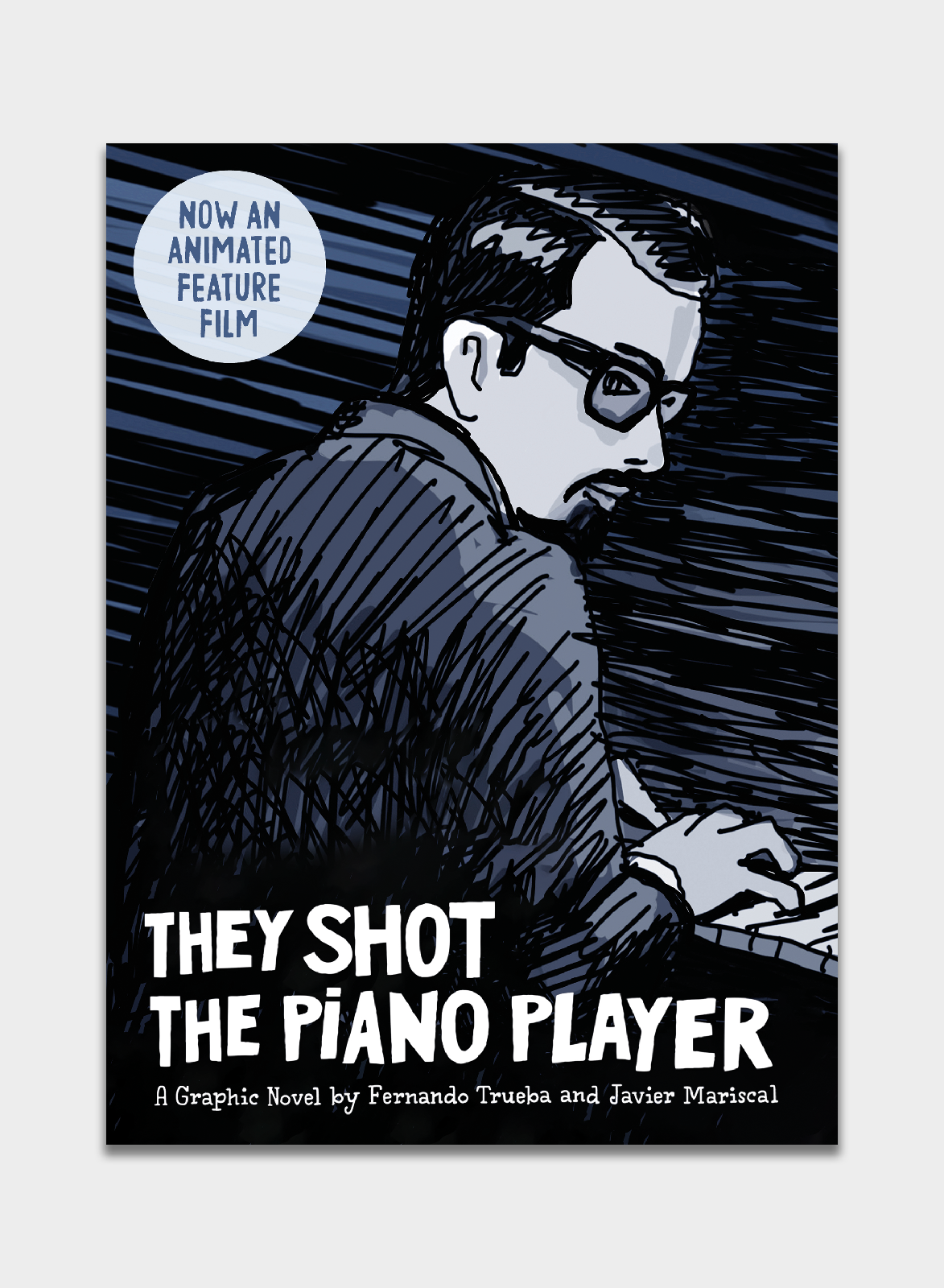
Graphic Novel Review: They Shot the Piano Player: The Graphic Novel

reviewed by Elk Paauw, PhD Student and Lecturer, University of Western Ontario

Fernando Trueba and Javier Mariscal; translated by Edward Gauvin. They Shot the Piano Player: The Graphic Novel. London: Self-Made Hero Publications, 2024. ISBN: 9781914224249. $34.99. https://www.selfmadehero.com/books/they-shot-the-piano-player-a-graphic-novel

While They Shot the Piano Player has been touted by The Indiependent as “a graphic novel to rival Maus or Persepolis,” this comic adaptation of the 2023 animated film of the same name fails to deliver the same syncopated rush as the jazz-soaked movie. The story follows a journalist from New York whose obsession with the mysterious 1976 disappearance of the Brazilian pianist Tenório Júnior on the cusp of a military coup in Argentina, takes readers on a whirlwind tour of the rise and fall of bossa nova and democracy in South America. This is the second graphic outing for Fernando Trueba and Javier Mariscal, the writer-artist/co-director duo behind 2010’s Academy Award-nominated film and (subsequent comic book) Chico and Rita. Published by London-based imprint, Self-Made Hero, this book falls into a similar trap of being narratively invested in music only to be portrayed by a silent medium. Many of the visual choices in translating the film to the page are questionable, proving that ultimately this story worked better via moving images rather than sequential ones.

Jeff, an American journalist interested in Latin jazz, gets consumed by the story of an obscure Brazilian pianist who disappeared during the military coup of Argentina in 1976. The framing narrative consists of a book signing in New York City where the journalist launches into the saga of discovering the truth behind Tenorio's cold case through a series of talking head interviews, featuring a who's-who from the history of Brazilian popular music. The story follows Jeff flying to various South American locales in pursuit of anyone and everyone who might have information regarding Tenorio's disappearance, including the pianist's ex-lovers, musical collaborators, and surviving family members. So as to not spoil the mystery, suffice it to say the labyrinthine tale of Tenório’s disappearance is eventually revealed as being politically-motivated. It is unclear if the narrative arrives at the final truth of Tenório’s case, as the man who "confessed" was convicted later for fraud, but it also becomes clear that as a case of kidnapping and disappearance, there will never be any true relief for those who survived him as they never got to say goodbye. In the end, the book reads like a jazz documentary / travelogue meets a chilling whodunit, providing a history of the bossa nova movement and its downfall while also highlighting the material impact of the CIA-backed Operation Condor on the lives of everyday people.

                Some strengths do stand out in the adaptation, including the one I looked most forward to in the writing of this review. The sheer density of the scenic panoramic shots and the cozily-over-stuffed interiors made the film ooze with tiny background details. I craved being able to sink further into Mariscal’s visual world by poring over his drawings in book form. To get a widescreen shot of Rio de Janeiro, with mountains peppered with rooftops and beaches bursting with umbrellas, but only be able to glance at it for 20 seconds was downright cruel. For readers to be able to actually immerse themselves in the imagery and luxuriate in the tightly sketched locales was my justification for even considering reading the book version. Additionally, the color pallet of the film, particularly during the musical segments, was also ripe for adaptation, to let the saturated orangey reds and turquoises – and the iconic blue note blue of the cover – sing in print. The story itself is a fascinating history of the relatively brief zeitgeist of bossa nova music, while evergreen with its discussion of totalitarianism and the role of the state in the movements of culture. In the bonus essay in the back of the book, Trueba’s announces his goal for the film was to “resurrect” the vanished Tenório (233), arguing that animation was “the ideal form, the ideal language” for his story; this makes one wonder why he decided to make a comic book adaptation after all.

                The main critique of this work is that the comic does not have a cartoonist's touch; the “talking heads” style of documentary that the film pulls off in a novel way through the use of roto-scoped animation does not translate well into comics, except in parts where the interviews feel more like a dialogue (see the dinner scene with Suzana de Moraes, daughter of jazz musician Vinícius de Moraes, on pages 38-41). Every panel is taken directly from the film, without a shred of new material other than some sketches of Tenório in the back along with a handful of stills that were cut. The only change to the imagery was re-framing shots to fit into panels along with the addition of hand-drawn sound effects and emanata. In terms of framing, occasionally characters are zoomed in on to break up the monotony of the tripod interview segments. But, unlike zooming in with a real camera, these images are just blown up, showing the roto-scoped characters in even sparser detail. Compared to the intricate long shots of landscapes, these close-ups felt wildly out of place, making an uneven visual narrative. The shot-reverse-shot procedure for interviews makes for a tedious and formally bland comic as well, so transitions between scenes sometimes would make certain stills from the film into splash pages or two-page spreads to break up the rhythm of the text. However, the choice of spreads felt arbitrary, breaking up the narrative with images that did not scale up sufficiently, which looked cheap next to densely-packed panoramas jammed into tiny panels with no room to breathe. As a student of both comics and animation, I was surprised and disappointed with how jarring this visual mistranslation felt as a reader, but it did serve as a reminder that comics are not just film-lite.

                In terms of audience, ideal readers would be fans of the film or fans of bossa nova and Latin jazz generally. Those interested in a similar aesthetic experience but without the jazz might also enjoy the Aya series (Aya of Yop City, Aya: The Secrets Come Out, etc) written by French-Ivorian Marguerite Abouet and drawn by Clément Oubrerie, or Miss Don’t Touch Me by Hubert and Kerascoët. Oubrerie and Kerascoët both utilize a gorgeous color story, while Oubrerie portrays the bustling streets of Yopougon and Abidjan with loving detail. A more politically-charged work to read alongside Player would be Israeli cartoonist Rutu Modan’s Exit Wounds or The Property. While the Dramatis Personae in the back of Player is useful in keeping track of characters, and the special essay provides trivia and insight into the film’s production process from Trueba’s point of view, ultimately, I suggest just watching the film. Maybe next time, I should just buy a Mariscal print off his portfolio website instead to really sink my teeth into his drawings.

Friday, March 1, 2024

Nate Powell interviewed about Fall Through, his punk rock graphic novel (UPDATED)

Interviewed by CT Lim

 The March trilogy, written by the late civil rights leader and U.S. Congressman John Lewis and Andrew Aydin, and illustrated and lettered by Nate Powell, was one of the most acclaimed series in recent years. It is the first comics work to ever win the National Book Award and there is even a sequel now called Run. But most readers of that series will not know the artist of the books used to be in a punk band, ran his own punk label, and drew comics about the life. 

When I had the opportunity to review his new book, Fall Through and to interview him via email, I knew this is what I wanted to focus on. Reading Fall Through is like reading issues of Maximum Rock 'n' Roll and thinking about 'what is punk?', 'what is authentic?', and 'how does one carry on in your 40s and 50s after a lifetime of listening to rock 'n' roll, subscribing to its ethics and ideals when you have been working a 9 to 5  job for the last 20 years?' You realized there is a cap to what you can achieve in the rat race, in climbing the corporate leader. There are some things you just won't do and don't believe in. You can only be 'good' for so long, then you just got to throw a spanner in the works. Because it makes life more interesting. Some of these dilemmas are discussed in Notes from Underground: Zines and the Politics of Alternative Culture by Stephen Duncombe. 

I thank Nate Powell for his illuminating and generous answers to my questions. I learn that his punk characters are connected in his own story universe. I look forward to reading his new books.

How does one go from being a punk rocker to being an award-winning comic artist?

I began my active involvement with both communities simultaneously; In September, 1992, my band Soophie Nun Squad started writing songs as my bandmate and I published our very first comic book, D.O.A. #1. My comics pursuits were initially separate from my more personal fanzine creations, slowly merging as I realized that comics could be used to express whatever I wanted. Soophie Nun Squad’s first tour in 1997 doubled as the first time my comics were sold outside my hometown, and more importantly, read by any audience who didn’t already know me. These creative and social networks in punk and comics are both parallel and interconnected, and I’ve simply continued doing what’s been so meaningful for the past 32 years.

What are the lessons that you have learned from punk rock in general, and those that you have applied to being a comic artist?

Punk can be understood as a lens through which to navigate one’s surroundings and to better understand one’s relationship to the world. It can also be a means of problem-solving, figuring out ways to make things real on one’s own terms, and often with limited resources. It’s a test of faith in strangers and their intentions. It’s a crucial exercise in the value of critical thinking skills.

What we call punk is also a double-edged sword: it’s eternally defined and redefined by young people, and the older one gets, the more important it is to reevaluate those self-imposed values and structures we set in place as teenagers. The most enduring of these values in my middle-aged life are a strong do-it-yourself ethic, the necessity of community engagement and faith, and the unique strengths of comics’ democratized accessibility as an expressive medium. 

What I like about Fall Through is that it is not a straight narrative of a band on the run. It attempts to capture what it is to be on tour, the constant gigging, to be skint all the time and you feel you just can't get off the road. It's like reading an issue of Cometbus, more akin to George Hurchalla's Going Underground than Michael Azerrad's Our Band Could be Your Life. The latter is more structured while the former is more shambolic and a bit all over the place. 

Or am I reading it all wrong?

That’s definitely a big part of it. On the surface level of the plot, that disorientation and closed perspective is a powerful force when touring with the kind of band-family we see with Diamond Mine. But the tour aspect of the book is really just the scaffolding that holds deeper themes and feelings in relation to each other. A deeply personal creative collaboration like a punk band often carries a dynamic tension between band members’ perceived unity of purpose and the individual visions and motivations of its members. We sometimes lie to each other about these intentions, just as we lie to ourselves.

How much of the magic realism was there when you first outlined the story? Was it something that you had in mind or something that came along the way? (I thought it was a good way to make tangible the lure of the road, to keep on going and going and to put aside reality and the real world)

All of my solo fiction is magical or supernaturally-tinged, and it all takes place as isolated tales within a shared universe, allowing me to explore different aspects of my beloved hometown, its unique culture and people. So for Fall Through, magic was a given possibility during the early problem-solving stage of writing. Diamond Mine first appeared as a band in my 2018 book Come Again, performing in a weird mountain town in 1979. As I was developing these characters and their stories for Fall Through, which takes place in 1994, I embraced the fact that they simply don’t make sense in either era, and realized that this was a central mystery to help unlock the larger story. Finding a way to reconcile this without overexplaining it required reverse-engineering the band’s appearance in 1979, piecing together details which directly revealed the central plot issue, and allowed me to build around that mystery.

Are you still in a band? Will you form another one? 

I have been a parent for the last 12 years, and that takes up every second of my life. I’m also geographically separated from the people with whom I’ve been involved in all of my bands—when I say “band-family,” I really mean that. It’s proven to be very difficult to play music outside of that family, but has made any reunions very welcome. From 1992 to 2010 I was in the bands Soophie Nun Squad, Gioteens, Boomfancy, Wait, Divorce Chord, and Universe, all with overlapping membership. In 2023, I reunited with three other members of Soophie Nun Squad to play a tribute set to a beloved hometown punk band, Trusty, doubling as a memorial to their drummer Bircho, who passed away at the beginning of the pandemic.

What music are you listening to these days? What would you recommend? What would be a playlist to accompany the reading of Fall Through?

When I draw, I often listen to ambient electronic and minimalist albums on repeat—a lot of Harold Budd, Brian Eno, OK Ikumi, Oneohtrix Point Never, Philip Glass. I certainly spend a lot of time listening to emotionally vulnerable hardcore of the mid-80s to mid-90s—that’s my home planet. Lately, I’m constantly listening to Cocteau Twins, Prince, Siouxsie & The Banshees, Hugo Largo, and The Cure, as well as stellar new albums by Hammered Hulls and Scream.

I actually made a soundtrack accompaniment to Fall Through, which is here: https://www.youtube.com/playlist?list=PLF5hlx163lp15p6uNFVRtlIcKy3-81i3d

Some friends of mine (old punks) in Singapore are talking about planning for punk lives after 50, 60. Those who are not married or have kids, is there a retirement home for them so they can take care of each other. A punk house but with the old people safety features. This could be a real concern as people expect punks to 'grow up', settle down, have a proper 9 to 5 job, establish their careers. (one became a lecturer in an arts school and doing her PhD now on punk culture in Singapore, mining her own past) But some don't and there is some talk about punk old folks' home. 

Are there similar issues in USA? 

This is a good example of the importance of reevaluating how we apply these lifelong ideals crystallized as, and by, young people. There is not a serious issue with settling down and growing in different directions as we age. It’s simply what people do, and denying that requires an increasing denial of our relationships with the world—which is precisely how Diana has painted herself into an ideological corner with her own misapplied, self-serving idealism.

Punk is a way of approaching what we do, how we do it, and how to best look out for each other. There is no dichotomy-crisis outside of young adults who don’t yet understand this—and older people who refuse to acknowledge it. Punk is very real, and also a fabricated misnomer.

What's next after Fall Through?

In April, my next nonfiction book will be released. It’s a full comics adaptation of James Loewen’s influential Lies My Teacher Told Me, which is essentially a history book about intergenerational misunderstanding of US history through our history textbooks. The original version of this book was very influential on me as a young adult, and it has only become more significant as the power-hungry, reality-averse far right in the US have pursued organized campaigns to ban books and control information and diverse voices within the American experience. As for what’s on my drawing table right now? I’m finishing pencils on the prequel to Fall Through, which is both a stand-alone character study centered around Diana and the connective tissue fusing Come Again to Fall Through. It’s been a blast to dive so deeply into these characters’ lives and psyches, and will be heartbreaking to reach the end of the journey again.

Fall Through
BY NATE POWELL
Abrams Books, 2024
ISBN: 9781419760822
 $24.99
 
(Updated 3/2/24 with introduction)

Saturday, December 30, 2023

Book Review - Fall Through by Nate Powell


 reviewed by CT Lim

Nate Powell. Fall Through. New York: Abrams ComicArts, 2024. https://www.abramsbooks.com/product/fall-through_9781419760822/

So what do you do as a follow-up after creating the biggest books of your career? Well, you go for broke as Nate Powell has done here with Fall Through. Let's back up a bit. 

If you have been following comics or comics that have won acclaim and awards, Powell's previous books on American civil rights icon, John Lewis (the March trilogy and its sequel, Run) are as respectable as you can get. Notices in the mainstream media, national TV coverage and good reviews in all the right places. National Book Award winner!

But just like the Sex Pistols, who broke up after releasing one leave it or take it album, and right after their one-and-only shambling USA tour, Powell decided to go back to his punk rock roots which most of us have no clue about and what a story he has to tell. (although like a true punk, Powell, through his lead character, is critical of the Pistols for being the manufactured group they were).

The connections between comics and punk are not new. John Holmstrom, Love and Rockets, that cover of Sub Pop 200 by Charles Burns. Recently, I reread old issues of Peter Bagge's Hate, the run in which Buddy was managing a band and how everything just self-destructed while on tour. The story did not age well. 

The synopsis of Fall Through reads something like that: an "all-new trippy original graphic novel that's a love letter for fans of the indie punk scene of the 90s. Fall Through is one trip after another as a band, held hostage by their lead vocalist, are forced to repeat the same sets, same stops, same tour over and over again until one of the band members realizes what is happening and has to make a choice—the music she's struggled and fought so hard for, or reality?"

So what are Powell's punk credentials? Because it is all about street cred in punk rock. The notes say: "As for his music career, Powell was introduced to the hardcore punk community in 1991, played over 500 shows across North America and Europe in various bands, including underground legends Soophie Nun Squad and Universe, and managed the do-it-yourself label Harlan Records from 1994 to 2010."

Not bad although I have not heard of Soophie Nun Squad and Universe. But then again, most people in Singapore have not heard of the dumbass band I was in in the late 1980s, the Primitive Painters. But punk is an attitude, a way of thinking, an approach that I returned to from time to time. I can be good for only so long, but I can’t be good all the time. Punk prevails.

Fall Through captures that spirit quite nicely. How punk brings us together and pulls us along, but we need to return to real life after some time. But that is also not forever as the call of the punk goddess sirens will beckon us over and over again. Why do you think after slogging for 25 years as a chump and all burnout at work and having to take a year off of no-pay leave that I am attending gigs almost every weekend? Why would they even tolerate me and let through the door when immediately once I enter, I raise the median age of the room? Why bother when I need to know where the nearest toilet is and always look for the op corner (that's the old people corner). Why bother indeed when I have no chance in hell to chat up the cute punk women no matter what my loins say?

But. Punk embraces and punk can be inclusive.

To his credit, Powell has a compelling narrative (or beat, yes, we got the beat!) that drives the story. Something weird is going on, almost like a curse that keeps the band on the road with no end in sight. It's not all punk philosophy ramblings like what I have written above. I like it but I am not sure those not in the scene can get the references and the drift. But who cares? Powell doesn't over-explain or over-romanticize those days and nights of wine and roses. Being in a punk band can be stifling despite rhetoric of independence and freedom of expression. Pretty much like in a cell group or commune. There are equal parts of love and loathing, much like everything else in life. 

Reading Fall Through is like reading A Punkhouse in the Deep South: The Oral History of 309 by Aaron Cometbus and Scott Satterwhite and Going Underground: American Punk 1979-1989 by George Hurchalla. The only thing missing is a 7” as part of the book. 

You just go along for the ride. And it is good to be on the road. While it lasts with the wind blowing against your face. You squint and you drive straight on. 

Stand aside, open wide.