Articles from and news about the premier and longest-running academic journal devoted to all aspects of cartooning and comics -- the International Journal of Comic Art (ISSN 1531-6793) published and edited by John Lent.

Showing posts with label Malaysia. Show all posts

Monday, May 25, 2026

Remembering John Lent, part 8

John A. Lent with his book Asian Comics (2015) at the Art and Design International Conference (AnDIC) in Malaysia in 2016.  


 Thank you John Lent

 ”Thank you very much, Muliyadi.  With that amount, I have to stay alive for five more years.  [...] I appreciate your loyalty and friendship.  John”. 

Those were the words of John A. Lent in an email sent to me on Thursday June 24, 2021 at 12.20 am, after receiving a remittance of USD300 from me as payment to continue the subscription to the International Journal of Comic Art (IJOCA) which was founded and published by him.  Unexpectedly, his words came true when he passed away on Saturday, May 16, 2026 at the age of 90.

In 1991, two Mass Communication lecturers of Mara Institute of Technology (ITM) namely, Sankaran Ramanathan and Mohd. Hamdan Adnan introduced me to John Lent who was visiting Malaysia.  It was one of the most important moments in my journey as a lecturer and researcher of comics and cartoons as the friendship with John Lent paved a way for me to global cartoons and actively being involved in research on the art form.

In 1997, while doing my PhD research entitled Malay Editorial Cartoons: The Development of Style and Critical Humour at the Cartoon and Caricature Studies Centre, University of Kent, at Canterbury, in the United Kingdom, John Lent invited me to contribute an essay on “The History of Malaysian Editorial Cartoons” to the Southeast Asian Journal of Social Science (National University of Singapore, Vol.25 No. 1 1997) that he was editing, focusing on the subject of Cartooning and Comic Art in Southeast Asia.  John Lent’s invitation gave me an opportunity and a platform to publish the early findings of my research.   

That invitation was the beginning of many other projects and collaborations with him, including the book entitled Animation in Asia and the Pacific (London: John Libbey, 2001), the Society of Animation Studies conference in Australia (1999), essays in the International Journal of Comic Art (IJOCA), the book entitled Transnationalism in East and Southeast Asian Comics Art (Palgrave Macmillan, 2022 edited by him, Wendy Siuyi Wong and Benjamin Wai-ming Ng) and many more.  John Lent was a great supporter of my career and I am enormously indebted to him.

In 2016, while still teaching at the Faculty of Art and Design, Universiti Teknologi MARA (UiTM), as the Chairman of the Art and Design International Conference (AnDIC) organized by the faculty, we were able to to invite John Lent to deliver the keynote at the conference entitled ”Cyberology Relative to Themes and Issues of an Art Form Upstart-Comic Art” at the Concorde Hotel in Shah Alam, Malaysia on October 10, 2016.  It was indeed an honour to me and the faculty that he had agreed to come to the event as well as meeting with some local comic artists and cartoonists.    

John Lent was a role model who continously encouraged and inspired me to write and research.  His works have always been references for me as well as for my students, especially those who are doing research in visual culture, comics and cartoons.  He inspired us on the potential and the future of comics and cartoons as an art form as well as a field of study. 

John Lent was a very reverend and humble person who was very approachable especially in discussing academic matters related to comic art, the world of cartooning and media studies. He was a role model and inspiration for others. His passing is a loss to the world of comics and cartoons and his contributions to the field of study will always be remembered.  Thank you John!

 I send sincere condolences to his family and friends.

 Muliyadi Mahamood

Former Professor of Cartoon Studies

Faculty of Art and Design

Universiti Teknologi MARA (UiTM)

MALAYSIA.


John A. Lent

To:  me · Thu, 24 Jun 2021 at 12:20 am

Message Body

Thank you very much, Muliyadi. With that amount,

I have to stay alive for five more years. 😏I will

change your address.

I appreciate your loyalty and friendship. John


669 Ferne Blvd.

Drexel Hill, PA, 19026 USA
http://www.ijoca.net/

 A copy of an email sent by John Lent to me on Jun 24, 2021. 

DSC01195

John Lent with me while visiting an exhibition of Malaysian cartoons at the National Art Gallery in Kuala Lumpur, Malaysia in 2012.


John Lent with me and some other Asian comic scholars, from left Lim Cheng Tju (Singapore), Karl Ian Cheng Chua (The Philippines) and Hikmat Darmawan (Indonesia) at the Chinese University of Hong Kong in 2018.

 ----------------------------------

 I was fortunate enough to know and work with John for only a short period of time, but it was something I will always consider a significant honor. As a new comics scholar, the work he did in the comics world felt almost mythic. However, even more special was the fact that he had the rare quality of genuinely embodying that myth up close as well as from a distance. I have no doubt that he will be missed and remembered as long as we continue to study comics. 

 Grace Wright Hulme

Grace updated IJOCA's index for its 25th anniversary 

------------

"Blistering blue bibliographies! What's wrong with this engine?!?" On back roads in Africa, John Lent generally used a modified engine and gapped his spark plugs slighly smaller to prevent spark blowout under high cylinder pressures.

 Car Tuning in Africa - the lost InterGalactic Journal of Comic Art page by Gene Kannenberg Jr, Rusty Witek and Darko Macan.

Wednesday, January 1, 2025

Book Review: South East Asian Kommunity 2024

reviewed by  Duy Tano, of The Comics Cube commentary website and YouTube channel

South East Asian Kommunity 2024. Edited by CT Lim and Paolo Herras. Philippines : Komiket Inc., 2024. ISBN 978-621-8244-48-1. https://www.komiket.com/products/south-east-asian-kommunity-2024

South East Asian Kommunity 2024 is an anthology featuring creators from Vietnam, Myanmar, Thailand, Singapore, Indonesia, Malaysia, and the Philippines, edited by CT Lim from Singapore and Paolo Herras of Komiket Philippines. Personally, I am a huge fan of short stories and anthologies. This particular collection, one of the backbones of the Philippine International Comics Festival 2024, offers something for everyone, but to me one of the recurring themes is of confinement and escape.

Ping Sanisan (Thailand) kicks off the book with "Before the Curtain Calls," a sublime meditation on what life is like in South East Asia, while drawing the reader in with the use of color. Sanisan explores a fundamental theme of being Southeast Asian -- the perpetuation of your role in your family and in society, simply because of the circumstances into which you are born. It revolves around a dream sequence and is rendered in striking colors, most notably red. Nicely in contrast is “The After” by Erica Eng (Malaysia),* a black-and-white sci-fi short story set in the future, depicting the mundanity of life for everyday people. Eng’s story showcases that even as societies evolve and progress, people are always looking for something else to do, and perhaps something more.

Societal expectations and circumstances can feel like a prison, and it comes as no surprise that in an anthology such as this, we see several stories about escaping. "Le Beauttom" by Juliette Yu-Ming Lizeray (Singapore), about two children who get a job in an underwear factory, is probably the funniest story in the book, and is created by someone originally from Malaysia who moved to the United States before settling in Singapore. "Son of Krypton" by Chappy Fadulon (Philippines) equates a standard “Filipino leaving the country to pursue better opportunities” story to the origin of Superman, a storytelling device that would always resonate with me. I think it also works more broadly, since Superman is often noted to be an immigrant, but immigrant stories in general do not equate back to Superman’s journey.

In keeping with the theme of escape, Yuri (Philippines) dedicates "Mawalang Galang" to all runaways, and is about the fragility of familial relationships in society, and how sometimes one has to break things in order to rebuild them. She also has the single most striking image in the entire book, a splash page that made me go "Wow." "Love, Remember" by June Dao (Vietnam) is a heartbreaking story about two siblings who are reunited ever so ephemerally and will resonate with anyone who has ever been away from their sibling for an extended period of time. "Metamorphosis" by Wooh Hmo (Myanmar) is equal parts Kafka's Metamorphosis and the legend of Icarus, with a grounding in reality and an art style that evokes the best horror comics. Literally about escape, it is another story by an artist living away from his home – Wooh Hmo is in exile in France.

Not all stories in the collection fit a theme of geographic and cultural confinement and escape, however. "Until When" by Tita Larasati (Indonesia) is a short graphic memoir about recovering from a stroke, which includes pages drawn during recovery. I really do believe that personal stories like this are uniquely suited to comics, in a way that they are not for other media. It is the only medium in which you can showcase someone learning to draw again by actually showing the drawings that they did in that time period.

Other stories may call to mind familiar genres to longtime readers of comics, or are a bit more abstract. Overall, this is a solid collection of stories from the region, showcasing a wide variety of talent and subject matter. And it shows that even one feels a desire to escape, there are, in similar current circumstances, cartoonists with an abundance of talent, creativity, and imagination. May all these creators find the audience they deserve.


*CORRECTION: The original post incorrectly stated that Erica Eng is in Singapore; she is actually in Malaysia. 

Tuesday, October 31, 2023

Book Review: Drawn to Satire: Sketches of Cartoonists in Singapore by CT Lim and Koh Hong Teng.

 Drawn to Satire: Sketches of Cartoonists in Singapore. CT Lim and Koh Hong Teng. Pause Narratives, 2023. 144 pages, $26.89.

 reviewed by Felix Cheong


If one uses a metaphor of satire as the art of stabbing an issue to draw humor instead of blood, so too does the biographical Drawn to Satire -- in ways that are as inventive as they are at times infuriating. Therein lies the double-edged sword of this lovingly produced book -- you wish it could have done so much more, but paradoxically, so much less.


Written by CT Lim and illustrated by Koh Hong Teng, Drawn to Satire sketches, both literally and figuratively, the lives of eight pioneering cartoonists, from well-known names like Morgan Chua, to the relatively obscure Dai Yin Lang. While the chosen cartoonists tend to be ethnically Chinese males, the book also includes one Malay, Shamsuddin H. Akib, and one woman, Kwan Shan Mei – which begs the question if they were added as token gestures. I will return to this question later.


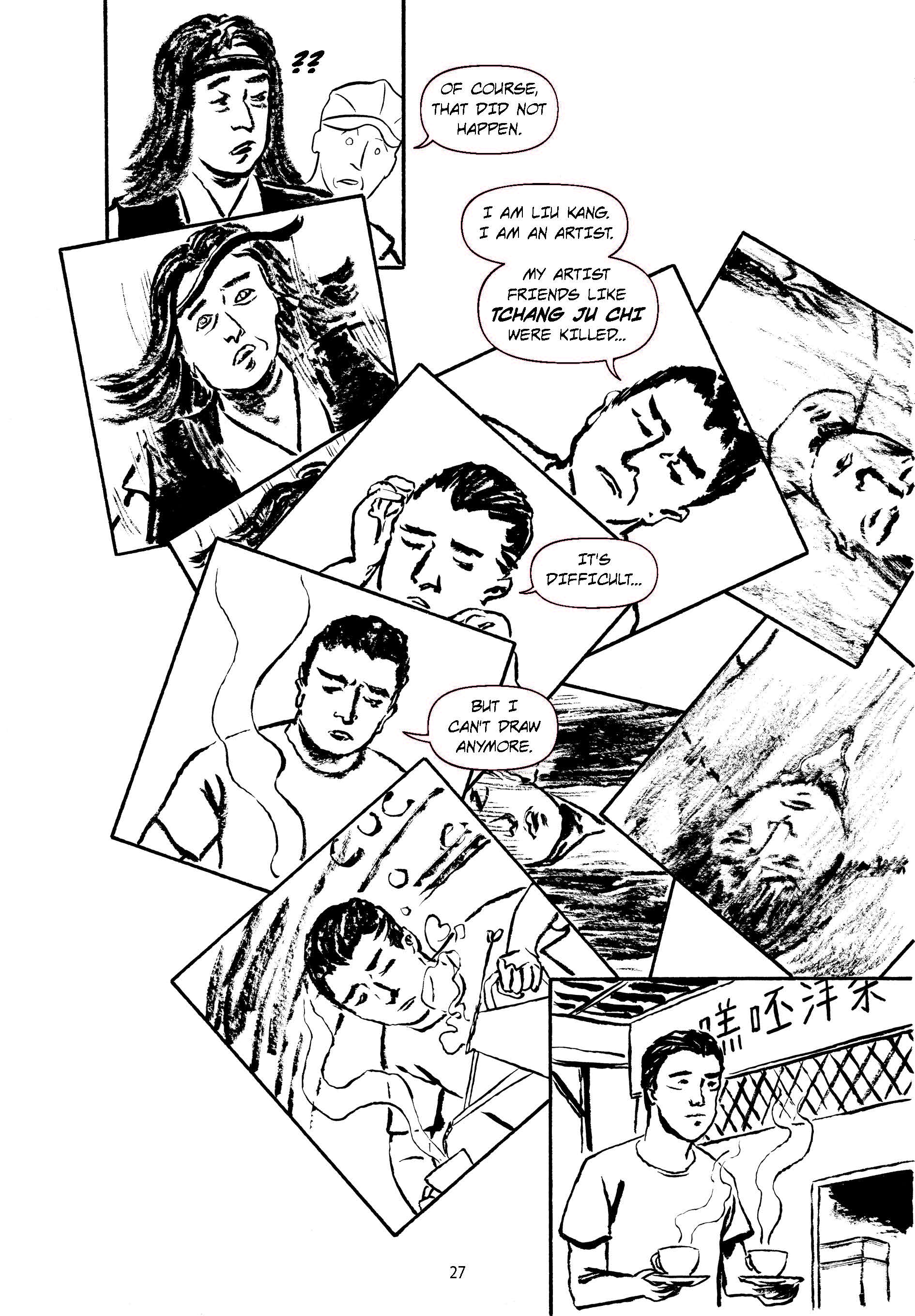
Each chapter begins with a quick overview of the cartoonist’s backstory and before you know it, drives directly into his themes, motivations and, occasionally, hang-ups. Here, Lim, the go-to authority on comics in Singapore, has obviously used his extensive research, having published previously on the history of comics (in particular, political cartoons) in the Lion City, in addition to being an IJOCA editorial advisor for the city-state. For this book, he has also conducted interviews with the cartoonists who are still alive, such as Shamsuddin and Koeh Sia Yong, and with relatives of those who have passed away, such as Tchang Ju Chi and Lim Mu Hue.


In keeping with its subtitle that the book is nothing more than “sketches,” each chapter (14-15 pages) reads rather, well, sketchily. It is akin to the experience of speed-dating, but on the printed page; just as the reader gets into the story – whoosh! –  it is gone. 


A case in point: the opening chapter on Tchang Ju Chi, a political cartoonist who was abducted by the Japanese military and presumably executed during the Sook Ching massacre of 1942. He was only 38 years old at that time. While the narrative tries to know the man, instead he comes across as a type -- the Chinese émigré with apron strings still knotted tight to the motherland, rather than a person in his own right. The in-your-face thought bubbles do not help by merely telling, rather than showing why, that despite having found his calling in Nanyang, Tchang still harkened back to China and viewed Sino-Japanese tensions with growing unease.


Indeed, if Drawn to Satire has a failing, it is how it sacrifices depth for breadth. Instead of featuring eight cartoonists, it could have gone with just five. Pioneer artist Liu Kang, for instance, could have been dropped; after all, his life is already well-documented and his comics output was limited to just Chop Suey, published in 1946Similarly, Kwan Shan Mei’s reputation rests on her children’s picture books, rather than satirical cartoons. Perhaps she was included to showcase a fair representation, but much of her chapter is devoted to conjecture and a summation of the authors’ intentions for the book. And while Din Yin Lang’s life certainly makes for an intriguing espionage tale, too little is known about him to be anything more than a sidebar.


So, while covering eight cartoonists might fulfill Key Performance Indicators (KPIs) required by funding bodies – the authors acknowledge support from four institutions, such as the National Heritage Board, the Singapore Chinese Cultural Centre, and Nanyang Academy of Fine Arts – the book does itself a disservice when more could have been done with less. 


Still, Drawn to Satire is a breezy read, helped, no doubt, by Koh’s unfussy art style, and at the same time, pays homage to the cartoonists by reproducing their works (and even two iconic Singapore paintings, Liu Kang’s “Artist and Model” and Chua Mia Tee’s “Epic Poem of Malaya”). 


What ultimately sells the book for me is Lim’s unconventional storytelling, which takes a leaf from the growing creative graphic biography field. Instead of writing a Wikipedia-like chronology, Lim dips into each cartoonist’s life and extracts specific incidents that define and shape him. More interestingly, he introduces an interloper (or provocateur), a fictional foil who flits in and out of the panels with time-travel ease and with whom the cartoonists interact. This unnamed character (who sometimes breaks the fourth wall) creates a Brechtian effect, a narrative device used either for Lim to set the context of what you are reading, or to slather asides and editorial comments.


In fact, Lim even cheekily inserts himself into the narrative; after all, he is as much part of the comics ecosystem in Singapore as the cartoonists he writes about, but he does it in a way that neither grates nor gloats. If anything, his self-referential character borders on self-deprecating, particularly in a funny sequence when he is depicted as a clueless emcee at the launch of Koeh Sia Yong’s art exhibition in 2023. Indeed, as befitting a book about satirical cartoons, humor is its chief calling card; sequences such as Morgan Chua fleeing to Hong Kong (to avoid the Singapore government’s crackdown on The Singapore Herald, a newspaper it had deemed subversive) have a Looney Tunes zaniness.


While it is not perfect, Drawn to Satire is what the comics scene in Singapore needs – it plugs a gap of scholarship and, in equal measure, is entertaining and enlightening.   


Monday, August 14, 2023

JUST A SIMPLE MAN: The 1994 Lat interview

by Lim Cheng Tju

 (this article originally appeared in print as JUST A SIMPLE MAN. The Lat interview by Lim Cheng Tju in a Singaporean magazine, BigO (Jan 1994), pps. 59-60. It is reprinted and available outside Singapore for the first time here)

Mohd Nor Khalid is a traditional kind of fellow. Better known as Lat, the Malaysian cartoonist is familiar to us in this region. But his works have also gained quite a following in the United States. But despite the fame and the high regard others have for his works, Lat retains a simple lifestyle. He also carries the past with him and he will share it with you easily over a cold beer or just laying back in a storeroom at the basement of Nee Ann City where this interview was conducted. And there’s much laughter during the interview. Perhaps it’s the man’s way of overcoming a certain shyness among strangers. And the stories a way to reach out to another human being.

LIM CHENG TJU: Do you consider yourself as a political cartoonist?

LAT: No. I don’t do political stuff. It’s social commentary. So, once a while I draw probably prime ministers, minsters, prominent people because these people everybody knows. People talks about. But not politics.

CT: So you don’t think your comics will change people?

LAT: No. You can’t change anything with drawings… never. I don’t know about the future or whether somebody has done it. That’s not the reason for drawing. It’s to get in touch with people, you know, to communicate. But if you read the Chinese papers in Malaysia, you get a lot of political ones but quite mild, I think.

CT: Do you think there is room for political cartooning in Malaysia?

LAT: Yeah. But it’s too late for me anyway because I‘m known to people that I deal with certain things. Like simple everyday life, scenery of Malaysian life, street scenes, living room scenes.

CT: You having been freelancing since you left The New Straits in 1984. Was it a difficult decision to make then?

LAT: I was one of the first to go out on my own and yeah, there were actually some days I was worried because at that time I have a child. My first child, so no more of these benefits, you know. But it’s fun. When I left The New Straits Times to be on my own, it was because I have been going around and meeting cartoonists all over the world and they are all freelancing. Many work at home and I learnt that’s better. There’s freedom. But at the same time there are more responsibilities. You are on your own.

CT: Is there a community of cartoonists in Malaysia?

LAT: Yeah, we have an association. I’m the president. It’s the second year. Many of the younger cartoonists are still in their 20s. They draw for Gila Gila (a Malaysian version of Mad magazine) and other magazines. They are good but we’ve got to give them time because sometimes you don’t know how long a person wants to stay as a cartoonist. They might just want to move on. Yeah, I do want to help them get published. I hope they will come up to me and offer me their work. But sometimes with cartoonists it is quite difficult. I know my character. I look at myself and I know all are the same. All cartoonists are almost the same. Very difficult to deal with. Sometimes you go an approach them, you get nothing. Sometimes if you wait for them to hand over something to you, to offer something, you also get nothing. So I don’t know… we just wait or what.

CT: Will there be a sequel to Mat Som?

LAT: I don’t know… I did that book because I want parents to know about how their children work and live in the cities. It’s the same over the world. If I look around, it’s being done in other countries. The same thing. The same story. They think their children are doing very well. In my time when I first came to Kulua Lumpur, there was very little pay and I had to struggle. And every time I went back to Ipoh or to the kampung they were treating me, you know, as if I was making it in the city. They would ask about life in Kuala Lumpur and they thought it was a glamorous life. But actually there are so many things you have to go through but it’s better to go through all these hardships than just to be spoon-fed. You know, you get everything you want by 23, like what has happened to some people. By 26, they’ve got everything waiting. Finished college and then they’ve got a job waiting. They’ve got a car waiting. You don’t really know what is real hardship and work.

I have done some 40 to 50 pages for the second book. But I don’t know when to finish it. So like I told you, there’s always something waiting for me to do at home. It’s nice you know but then you get tired of it so you do other things. Now I’m collecting books on ancient boats. Mostly from our part of the world. The sea route. I don’t know what I want to do with them. But I can see that that will be the background of something I will do later but I don’t what is it. So don’t ask me ... Maybe I want to do a story about Southeast Asia in ancient times.

CT: I found the panelling [i.e. panel layout] in Mat Sam to be very cinematic. Was that done on purpose?

LAT: Yeah, that was done on purpose. I got influenced by the Japanese way. I’m so used to newspapers drawings. One big panel, you know, so I want to do that. As for the small size format of the book, maybe I like it to look like a novel. But it’s a bit weak, the story. There’s nothing spectacular. So ordinary. For many it worked. But if I’m another cartoonist, I want him to be something different so that you can have this and that. Mat Som is still a kampoung boy in the first book. Now I make the other Mat Som in part two different. Maybe you’ll see that he’s no longer that shy kampung fella. He becomes at city rat. Shout at motorcyclists and cars and he’s got to move because his home that he is renting is being turned into a condo or something. So he’s moving to a squatter house. And he’s still not getting better off. But I’ll just leave that for a while. I don’t know. I haven’t done it because of this Kampung Boy animation project. But when I complete it, I might want to make it magazine size this time. I will still publish it myself but I don’t know when. I spend too much time on the animation now.

CT: You have been talking about the Kampung Boy cartoon in interviews since the late ‘70s.

LAT: Yeah, it’s a dream. So when this happen, I look forward to a series of it. But as you know, animation takes more than one person. It’s a team project. It’s meant for TV but it’s aimed at the international so there is a lot of story considerations involved. It will only be 26 minutes but it has taken me more than a year. I started on it July last year.

CT: How much of it has been done?

LAT: I have just finished the second storyboard and the production will start very soon. It may be completed this year. The funding comes from Malaysia but the animation itself will be done in Canada and Philippines. I am working with two Canadians rights now. One is the director and the other does the storyboard. In fact this guy who does the storyboard, he is quite a young man. He has looked at me too much. So much so that his Kampung Boy looks exactly like me. You know, a fat little kampung boy. So I say no. Make him a thin boy because this was when I was a kid. Don’t look at me now!

CT: Going back to an earlier autobiographical book, Town Boy, can you tell us about your childhood friendship with Frankie? (a Chinese boy whose parents own a coffee shop)

LAT: Many people have asked me that. But what can I say? Frankie. I cannot tell you whether there’s a Frankie. I don’t think anybody in my class would be able to come up to me and say we know who’s Frankie but is that his real name? But I tell you. When I went to that house above the coffee shop, I think I was in Standard 6. So it was a happy occasion at that time. There was also pop music. We became friends because of music. We talked about the music. We talk about the Beatles, other singers and when a new hit came out, the feeling that you get … the morning you wake up and you hear the song, wah! you know and then you cycle and you go see a friend and discuss and then we later learnt to play. We also formed our band. We did "Yellow Submarine" with the special effects. So that’s all. You know youth and excitement. I remember all that because it’s in my head. To get that kind of excitement is so difficult if you look for it. So it’s appreciation. You appreciate music. It’s good. It’s better to appreciate music. It’s better to appreciate something and then you have someone in common to share with you. That’s better. Even politicians cannot tell two boys you must be friends. They say look at the other fella, why should I be his friend? But because of music, because of art, you know, you become friends.

CT Lim, Lat, and Miel in 2009 at Lat's kampung.

CT: I suppose most of your stories are created out of a feeling of nostalgia, having to grow up in a kampung and then to move to the city. You said once that the more you listened to Neil Young, the more you wanted to go back to the kampung.

LAT: I think Neil Young has got an album called Old Ways. He was singing some old songs also. So, it’s not only me. Everybody has that nostalgia thing, you know. First when you are in your 20s, you suddenly realize you are an adult. So, you miss school days. That’s the first nostalgia trip. Then when you are in your 30s, you miss bachelorhood. Then when you are in your 40s, all sorts of things, many things. Like in my case, I miss the quiet life because, you know, the children (Lat has four of them) make so much noise. So sometimes I really wish it could be nice if it’s quiet. But then because we are so used to all the noise then when it’s so quiet, the children are missing, then you say, ah, it’s good if you could hear the noise. It’s that kind of thing.

Nostalgia is … you know. Some people have it more than others. But there’s nothing much you can do about it. And you must not live in the past, of course. You look back so that you know the changes. Like me, I look at the children and I say we spend too much money now because in those days there was not money needed. No money at all for children to play. Now if you take them to the shopping complex and then you got to pay to play the computer games and all these electrical things. So the children, what they know is where to put the money in. Even the two-year-old. You need it to put it there or else the thing won’t move.

We didn’t know that because we were playing very different games. So that’s why I tell the children so that they know. Parents need to talk to their children. Just to bring them together. That’s all. It’s a very common thing. Also I tell the children and families to just hold on for a while and not to go too fast because we’re going too fast with everything. So that’s it. Hold on, you know. Just some years ago I remember, we didn’t have to pay like this. So is it necessary?

You know, usually Malaysians are not … the normal kampung way of life is always be modest. That’s what everything is about. Be modest and that’s why I always get scared when I have to spend money for children. Every time my children ask for money and I would say what? Because it’s so unnecessary. Let’s have something very simple, lah. Not so expensive. It must be cheap. Better for me. That’s why even my book (Kampung Boy Yesterday and Today), which costs $12.90. Now friends already call me up and say how come so much? I say, “I’ve got some people coming with ideas to do coffee-table books. They want to sell for M$150. You pay M$12.90 and you’re already complaining, eh?” But you know the cost of printing and the cost of paper? Already gone up. So that’s what I do.        

CT: How do your children look at the world of Lat?

LAT: Well, first of all, when I told them I was living on a house on silts, they didn’t believe it. How can you live like that? No TV? No one believes that there’s no TV because you wake up in the morning and you see the TV. So yeah, in a way I sympathize because they don’t have the space. They live in a little compound so they don’t have it. For them to run you have to take them to the park. So I try my best to take them out of town to the rural areas and show them.

Note: (1994) Thanks to Johnny Lau for arranging the interview with Lat. (2023) Thanks to Karen Goh for re-transcribing the interview from the 1994 publication.