Articles from and news about the premier and longest-running academic journal devoted to all aspects of cartooning and comics -- the International Journal of Comic Art (ISSN 1531-6793) published and edited by John Lent.

Showing posts with label Marine Corps. Show all posts

Monday, January 19, 2026

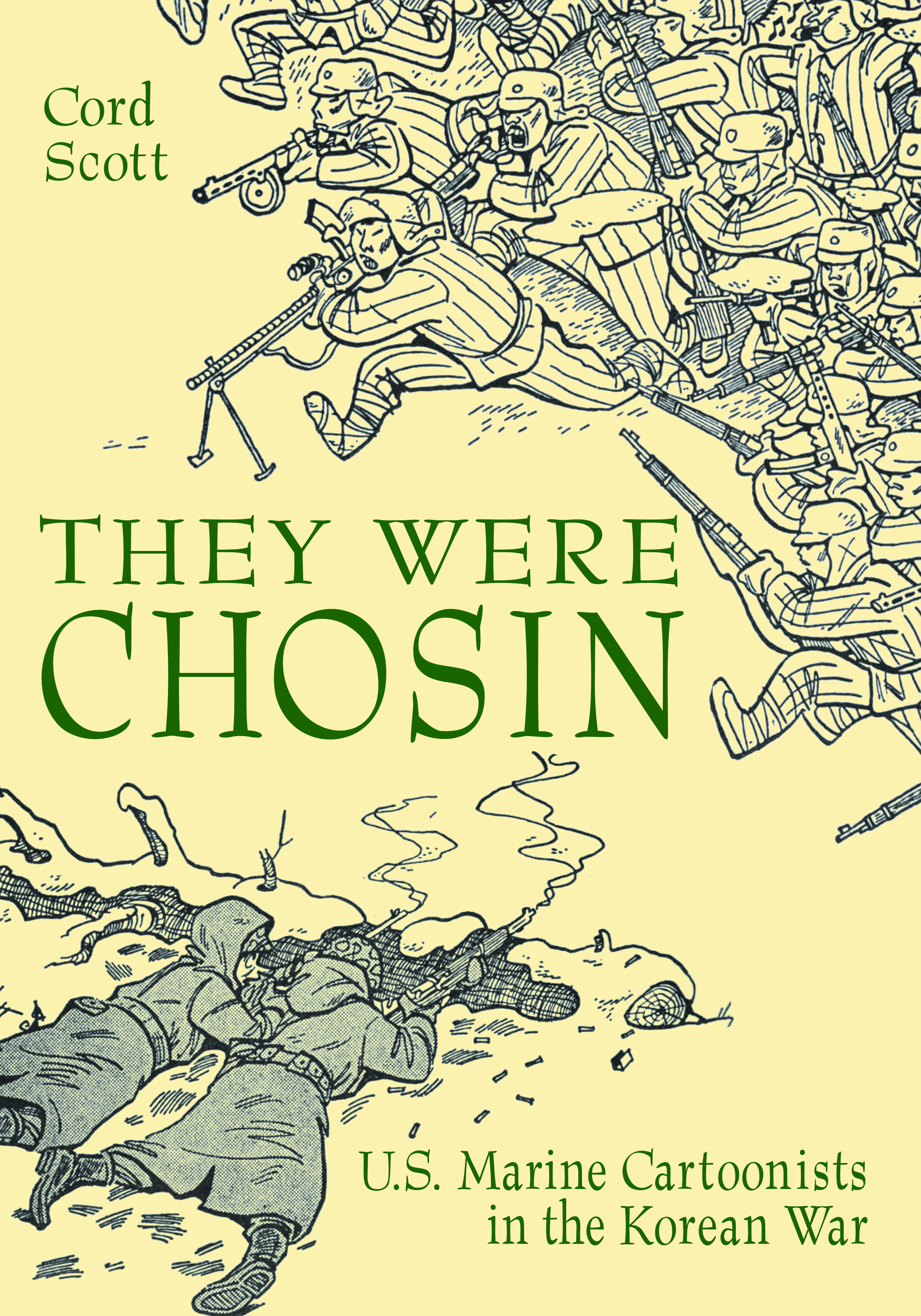
Book Review: They Were Chosin: U.S. Marine Cartoonists in the Korean War

reviewed by James Willetts


Cord A. Scott. They Were Chosin:  U.S. Marine Cartoonists in the Korean War. Quantico, VA: Marine Corps University Press, 2025. 234 pp. Free epub and pdf. ISBN #:  979-8-9878492-0-0.  https://www.usmcu.edu/Outreach/Marine-Corps-University-Press/Books-by-topic/MCUP-Titles-A-Z/They-Were-Chosin/


     They Were Chosin, like Cord Scott’s previous work, The Mud and the Mirth, serves to highlight the cartoons produced by and about members of the U.S. Marine Corps. Published by the Marine Corps University Press, it blends reprinted material with visual analysis and histories of significant creators, offering insight and depth about the Marine Corps’ wartime publications. This time, Scott turns his attention to the illustrations from the Korean War, focusing in particular on Norval E. “Gene” Packwood’s Leatherhead:  The Story of Marine Corps Boot Camp and Leatherhead in Korea.


Available both in print and as a free epub and pdf from the Marine Corps Press, They Were Chosin showcases some of the material produced by, for, and about the Marines during wartime. This, alongside Leonard Rifas’ 2021 book, Korean War Comic Books, and Paul S Hirch’s, Pulp Empire, continues to serve as correctives to tendencies to ignore wartime comics after 1945, especially those of America’s “forgotten war.”


The majority of They Were Chosin concentrates on the art of Packwood, who produced two books about (and for) the Marine Corps in Korea. While Scott also addresses other cartoonists of the period, and comics about the war, these are largely relegated to footnotes. Yet, at the same time, Scott gives the reader little information about Packwood, instead, choosing to devote the vast majority of the book to reprints of his cartoons, particularly those from Leatherhead and Leatherhead in Korea.


The ultimate strength of Scott’s work is in the reproduction of this material. The book contains 134 images, which are printed clearly, and in high fidelity across 234 pages. A mixture of color and black-and-white illustrations, They Were Chosin demonstrates the admirable commitment by the USMCU to improving on The Mud and the Mirth, their first foray into comics scholarship. The cartoons in The Mud and the Mirth were often difficult to parse and read, owing in part to their reduced size and the placement of multiple cartoons and comic strips together, which meant that text in the cartoons was almost unreadable. By contrast, They Were Chosin is printed in an oversized 7x10 paperback format, and the full-page illustrations are much clearer. This adjustment is a marked improvement over the format of the first book.


At the same time, there are still some stylistic kinks to work out. The first is that, as an image-heavy book, chapters include only a minimal amount of analysis, with brief snippets of text intercut with large chunks of reproduced cartoons. Chapter Two (“Norval Packwood and the Creation of Leatherhead”) features only four pages of text to eighty-eight images, with text on pages 15, 16, 74, and 76. Likewise, Chapter Seven (“The Modern Era,” which references British cartoons about the Korean War) is only three pages long, includes two half-page illustrations, and contains barely enough text to fill a single page. This leaves scant room in these chapters for historical contextualization, biographical information about creators, or analysis. Perhaps the best option here would have been for this book to be released with fewer images alongside full reprints of Packwood’s Leatherhead:  The Story of Marine Corps Boot Camp and Leatherhead in Korea, allowing Scott room to dig deeper into these cartoons and their meaning. While the press makes clear that this is “not meant to be a definitive visual history of the Korean War,” further exploration and writing about these cartoons within this monograph seems necessary to avoid it being anything more than a brief primer. Scott’s brief history on the course of the war, intended for readers who may be unfamiliar with the broad strokes of the conflict, is an excellent example of his ability to blend military and cultural history and could easily have been expanded on to tell a more complete historical story of the Marine Corps in Korea. This is ultimately an area where The Mud and the Mirth set a standard that They Were Chosin fails to live up to.


Ultimately, the lack of broader analysis holds They Were Chosin back from being an essential history of the Korean War’s military comics, limiting its reach. Instead, it seems to set up future works on the illustrations produced by, about, and for the Marines during the early Cold War. While it will invariably be an important read for anyone interested in the comics of the Korean War, it feels like a missed opportunity to write the definitive account of the Marine Corps’ comics during the period, and tell a larger and more substantive tale.


A version of this review will appear in print in IJOCA 27-2. 


Tuesday, November 22, 2022

Book review: The Mud and the Mirth; Marine Cartoonists in World War I by Cord Scott

reviewed by James Willetts

Cord Scott. The Mud and the Mirth; Marine Cartoonists in World War I. Quantico, Virginia: Marine Corps University Press, 2022. https://www.usmcu.edu/Outreach/Marine-Corps-University-Press/Books-by-topic/MCUP-Titles-A-Z/The-Mud-and-the-Mirth/and https://www.usmcu.edu/Portals/218/The Mud and the Mirth_web_1.pdf

This is the Marine Corps University Press’ first book of comics analysis and criticism, focused on the pre-first world war and wartime cartoons published by - and about - the Corps. Available for free as a .pdf, the Press show an admirable commitment to public-facing history with the publication of a wide assortment of archived cartoons. It’s a lavishly illustrated monograph, featuring over a hundred full color and black and white images, many of which are made widely available here for the first time.

Scott begins his analysis of military cartooning with an interesting point of departure from typical approaches. He notes that analysis of wartime cartoons usually begins with the patriotic commercial comic books, propaganda, and cartoons of World War II. Indeed, this is where Scott himself began his earlier work, Comics and Conflict, which looked at military cartoons from WWII through to the War in Iraq. In The Mud and the Mirth, however, Scott looks backwards, making a case that the cartoons and imagery published between 1914 and 1918 are part of a longer continuity. He argues that this framework allows readers to observe the “succession of cartoons that told of the Marines’ life well after World War I, into WWII, Korea, and even to the present day.” (4) The cartoonists, publications, and illustrations of the Marine Corps during this period laid the foundation for future military cartoons and comics. These materials are often neglected, to the detriment of broader conversations about military cartooning, wartime propaganda, and explorations of the Marine Corps’ internal culture. Likewise, Scott suggests, the authors and artists who created the sequential strips of the in-house publications have largely been overlooked both by historians of the Corps, and those focused on the development of sequential mediums and comics.

The Mud and The Mirth is structured around the Marine Corp’s pre-war and wartime publications. Scott first addresses pre-war depictions of the Marine Corps in the internal magazines Recruiters Bulletin and the Marines Magazine. These in-house publications specifically addressed the roles and daily lives of Marines stationed around the world. Scott acknowledges the influence of these early publications on crafting imagery that would continue to define the Corps going forward. However, the focus of the book is primarily placed on the cartoons of Stars and Stripes. Over two thirds of the book’s content – and the vast majority of the images contained within – cover the artists and cartoons of Stars and Stripes, published by the Army, but a multi-service newspaper.

These sections are illuminating. Almost all of Pvt. Abian A. “Wally” Wallgren’s Stars and Stripes cartoons (in the Army newspaper) are reprinted,* including all of those from the magazine’s page seven which was most commonly used for the Marine’s illustrations. Wallgren was one of the two people of the newspaper’s art department. Scott explicitly makes the case that the work of these servicemen artists demands further research and analysis. The books greatest triumph, then, is how it skillfully opens up the Marine Corps’ archives for further study. Images from Stars and Stripes, Recruiters Bulletin and Marines Magazine demonstrate the global reach of the Marine Corps and the wide array of activities Marines were involved in. The illustrations in Marines Magazine showing American perceptions of Haiti seem particularly significant and could easily be the main focus for an extended chapter on presentations of race in these cartoons.

Indeed, Marines Magazine and Recruiters Bulletin in particular would benefit from further analysis. While these are not Scott’s primary focus, it would have been nice to see more attention paid to the two pre-war magazines and they place they occupied in the development of military cartooning. A secondary author, or even a curated anthology, could have expanded on Scott’s argument and added deeper analysis of the Marine Corps’ cartoons of the First World War. This represents a missed opportunity from a smaller academic press. While the 20 pages Scott gives to cartoons from pre-war magazines represents almost a fifth of the total length of the monograph, it is not enough space to fully explore these in the same detail as Stars and Stripes.

Nonetheless, this is a useful and necessary correction to the established literature. Hopefully this will somewhat reorient historians of the Marine Corps as well as scholars of war comics and military cartoons. It leaves open room for new and ongoing avenues of research, and for others to take up Scott’s initial inquiries and develop his arguments further.