Quynh
Than is the co-founder and editor of Du But Books in Ho Chi Minh City and the
publisher of this book.

Images from the book can be seen in the review at https://vietcetera.com/vn/gui-nhung-trai-tim-can-dam-dang-theo-duoi-dam-me
Quynh
Than is the co-founder and editor of Du But Books in Ho Chi Minh City and the
publisher of this book.
Images from the book can be seen in the review at https://vietcetera.com/vn/gui-nhung-trai-tim-can-dam-dang-theo-duoi-dam-me
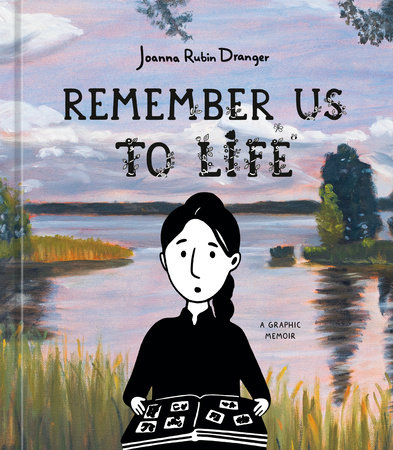
Joanna Rubin Dranger. Remember Us to Life. A Graphic Memoir. Berkeley, CA: Ten Speed Press, 2025. 432 pp. US $40.00 (Hardcover). ISBN: 978-0-5938-3690-3. https://www.penguinrandomhouse.com/books/769055/remember-us-to-life-by-joanna-rubin-dranger/
Remember Us to Life is an amalgamation of the history of the Holocaust and the lived experiences of Jews. Originally published in Swedish, the story follows the history of Dranger’s extended family, focusing on her grandparents, who lost family members to the concentration camps in Germany and Norway. The medium she uses to represent these stories applies the aid of a monochrome, black and white narrative, which is supported by the scattered use of color. The color is visible, when she uses original photographs, old handwritten memorabilia, and documents to emphasize the harrowing memories.
Throughout the book, Dranger is searching for a past that seems to be lost, or as she realizes, is too painful to remember. Her art shines through the story as her frameless pages, which intermingle with the stories, memories, and narratives, bring together the thematic of the memoir. She jumps between the present and the past, but, at the same time, she puts herself in the position of the survivors and imagines how different the experience would be. The story she narrates is specific to her family, but the way she presents it, is a story of every Jew during the years between 1935-1945. Her approach is multi-faceted, with the use of graphic illustrations, family photographs, and painting. Dranger attempts to construct the history of the lost family, but keeps her Swedish positionality as the focal point. Through the course of the memoir, she is seen critiquing Sweden’s role during World War II. The title itself envelopes the theme of the memoir, which is to never forget any of the lives that were lost during the Holocaust and to remember the atrocities vetted out on them.


reviewed by José Alaniz, University of Washington, Seattle
While reading Štěpánka Jislová’s extraordinary
graphic memoir Heartcore, which deals exhaustively with her love life’s
travails, more than once I was reminded of this passage from an early-2000s
Laura Kipnis polemic against love:
Love is, as we know, a mysterious and
controlling force. It has vast power over our thoughts
and life decisions. It demands our
loyalty, and we, in turn, freely comply. Saying no to love
isn’t simply heresy; it is tragedy
— the
failure to achieve what is most essentially human. So
deeply internalized is our obedience to
this most capricious despot that artists create
passionate odes to its cruelty, and
audiences seem never to tire of the most deeply unoriginal
mass spectacles devoted to rehearsing
the litany of its torments, fixating their very beings on
the narrowest glimmer of its fleeting
satisfactions (“Love”).[i]
Indeed, Heartcore is an intense,
sobering, and at times hilarious deep dive into 21st-century love
and relationships — or at least into a lot of things that people call
love and relationships. And this is key: an irreducible ambiguity lies at the
heart of Heartcore’s subject. As the author’s avatar informs us in a
prologue: “This is a love story.” On the next page, though, she amends the line
so that it reads, “This is a love break-up story.”
That clears things up.
Jislová, who graduated from the Ladislav
Sutnar Faculty of Design and Art in Plzeň, has built a strong reputation in
Czech comics over the last fifteen years. Apart from contributing art to
serious historical projects like The Czechs (Češi, 2013-2016, written by
Pavel Kosatík) and the graphic biography Milada Horáková (2020, written
by Zdeněk Ležák), she also does decent superhero satire, as seen in her scripts
for Supro: Heroes on Credit (Hrdinové na dluh, 2023, art by Viktor
Svoboda). She won the Muriel Award (the Czech comics industry’s highest prize),
for her art on the graphic memoir Bald (Bez Vlasů, 2021; English
translation 2024), a collaboration with writer Tereza Čechová.[ii]
Two years later she released Heartcore (Srdcovka, 2023; English
translation 2025), widely regarded as the first full-length single-author Czech
comics memoir. It won that year’s Muriel for best comics work.
Graphic memoir has existed for quite a
while in Western Europe, Japan and the US but has only recently emerged in the
Czech comics scene.[iii]
As we know, comics has a deep well of resources for the practice of putting
oneself down on paper in words and (perhaps more critically) pictures — what
Gillian Whitlock and others term autographics:
The signature of autobiography is
transformed in autographics’ touch on the page, and
memoir makes demands that draw deeply on
the provenance of the comics in return. Here,
autobiography escapes the rigid confines
of truth, authenticity and a singular coherent subject
and discovers the potential of comics’
multimodal visual/verbal pyrotechnics to transform
self-representation (238).
Jislová, who grew up with comics,
clearly grasps their potential for authorial self-examination; she produces an
at times startling memoir on the vagaries of the heart and loins, one in its
own way worthy of Aline Kominsky-Crumb or Phoebe Gloeckner — though she’s never
as explicit. (Few are). Stylistically and thematically, this is more mainstream
fare, but it’s also more wide-ranging than its illustrious predecessors; by the
end she’s gone beyond her own vexed relationship issues to explore society
itself’s enthrallment to Kipnis’ “most capricious despot.”
So, first and foremost, we should commend
publisher Graphic Mundi and translator Martha Kuhlman for bringing to
English-language readers such a groundbreaking work by a renowned creator from Central
Europe. Such publications remain all too rare.[iv]
That said, I want to put on the table now
my one objection to the approach utilized in this instance to transform Jislová’s
Srdcovka (a Czech word denoting something near and dear to one’s heart
which one recognizes as somehow flawed) into Heartcore. Kuhlman’s strong
and supple translation, presumably in a bid to “de-exoticize” the original for
non-Czech readers, anglicizes most of the characters’ names such that Štěpánka (pronounced
SHTYE-pan-ka) becomes “Stephanie” and Michal (pronounced MEE-khal) becomes “Mike,”
etc.[v]
Put me down as one against such “localization” of foreign language literary texts
in the name of familiarity.
Decisions like this, I realize, often do
not fall to translators, but to presses wary of weird foreign names spooking
away target readers. This strategy tends to backfire, though, when famous
people are mentioned in the text. I would imagine it’s jolting to anglophone
readers, after 150 pages of “Stephanie” and “Mike,” to see actual Czech names like
Bohumil Kulínský (choirmaster turned child rapist), Eliška Stěpánová (proFem
researcher) and Václav Havel (playwright/former Czech president). Reasonable
people can disagree on this question, but in an ever-homogenizing, Western
cultural imperialist world where the peculiar and local too often get retouched
into whatever goes down easiest in the target market, I remain an adherent of comics
scholar Kate Kelp-Stebbins’ mantra to “read for difference,” not sameness, when
we engage with comic art far from our shores.
Sermon over.
In terms of its plot, Heartcore
proceeds as a fairly standard memoir, one exceedingly focused on getting
some. “I must find a boyfriend,” says Štěpánka (sorry, I will be using
these people’s real names) (25). We follow our heroine through her middle-class
upbringing in the post-communist Czech Republic. I was quite taken with a double-page
spread of the neighborhood where she grew up, which many Central/Eastern
Europeans will recognize as the legacy of Soviet-era planned economy housing
policies: dilapidated concrete structures, a blocky quasi-brutalist health
clinic, what the Czechs call paneláky (tall prefab apartment complexes), a
Julius Meinl supermarket and a run-down derelict which Jislová labels “???”
(26-27).
From an early age, Štěpánka gloms onto
two things in a big way: popular culture (including comics and anime) and the stringently
policed gender roles she comes to understand everyone must embrace. For
example, she loves larping (live-action role-playing) and does it well, but a
group of boys forbid her from playing with them when they realize she’s a girl
(21). Even her beloved fantasy settings are not immune to the real world’s arbitrary
rules. In fact, she ultimately realizes that these immersive fictional worlds
were teaching her all along “what a love relationship is” (Aragorn and Arwen), “what
best friends are like” (the Czech series Fast Arrows),[vi] “what a group of
friends is like” (the Harry Potter series) (195).
But when it comes to relationships, life
ain’t Lord of the Rings. For Štěpánka love and desire become hopelessly
entangled with status (something she also obsesses over), with FOMO, with a
fiction-fueled quasi-performative suffering. “Having a crush is terrible but
not having a crush is terribly boring,” she writes in her sketch journal (55).
This becomes the grand theme of our heroine’s life, all through art school,
problems with alcohol abuse and beyond. It has closely proscribed limits, but Jislová’s
professed honesty is unflinching. She doesn’t shy from presenting her young
self as vain, shallow, prone to judging others, and selecting partners mostly
based on how well they will prop up her self-image. All this leads to the
excruciating on-again/off-again purgatory existence of life with Michal, the
attractive guy who refuses to commit, the one who after sleeping with her provides
enough of an ego-boost for her to think, “I guess I’m not that ugly
after all” (65).[vii]
The one who over and over breaks her heart because he’s not in touch with his
own feelings. The one who leads her on for years. “If I can’t have a
boyfriend,” she muses, “he’s the next best thing” (77).
 |
|
Fig 2. ‘How Does Anxiety Attachment Arise?’ From the didactic portion of Heartcore.
|
The repeated disasters that ensue eventually lead to Heartcore’s most remarkable narrative strategies. Pushing at what we usually mean by “memoir,” for a chapter Jislová radically switches perspective to that of Michal himself (echoing the structure of Dominique Goblet’s Pretending is Lying [2007]).[viii]
Then she abandons conventional narrative
altogether, turning to a didactic section exploring Attachment Theory, in which
she uses material from her own life and her many tools as a cartoonist to make
the tutorial come alive. This portion most resembles Alison Bechdel’s Are
You My Mother? (2012), though it’s a lot less wordy and has a lot more pop
psychology. While some might find the shift jarring, Jislová insisted to me in
interview that she wanted her readers to come away with something more than
just her own individual story; she wanted to teach them something so they could
connect the dots in their own lives. “[I]f I hadn’t put it in there, I would
feel like it’s incomplete, like I had planted the seed, but never showed the
flower,” she told me. One gets the sense, achingly, that in these concluding
sections the author is trying to penetrate as deeply as possible into the
mysteries that have brought her where she is – where we all are – to gain some
measure of self-understanding, self-acceptance, self-love.
Heartcore left this reader with many stimulating impressions
and associations. Here are some of them.
Women navigating a patriarchal world they
never made is a lot like a horror movie; it’s basically Men (d. Alex
Garland, 2022), the Jesse Buckley-starring feminist version of Get Out
(d. Jordan Peele, 2017).
Similarly, some people are terrified of
not being in a relationship, of being alone with their own selves and thoughts.
They really should ask themselves why.
Both social convention and instinct fuel
love mania. As the droning teacher in the Ukrainian high school drama Stop-Zemlia
(d. Kateryna Gornostai, 2021) puts it: “If we take a look at the
processes in the brain of a person in love, modern science says it can be
compared to a stress reaction. But only at the beginning. In this case, the biggest
changes occur in the subcortical structures, which are referred to as reward
centers.” Later on she says, “Enough about love, let’s get back to reality.”
Exactly.
Social media has by now utterly warped multiple
generations’ views of love, dating, desire, the whole shebang. It has
normalized cyberstalking, encouraged people to treat each other as disposable
objects, made the already fraught processes of finding companionship even more cringe-worthy
and fatally banal. I’m hardly the first to say this. Štěpánka in one scene tells
a guy there won’t be a second date — by e-mail as she’s walking away from him
(72). The internet makes cowards of us all. It’d be funnier if it weren’t so tragic.
This is what Kant warned us about, centuries before the first dating app: don’t
use each other as means to ends. You’ll be sorry.
Our romantic preferences come from all
over the map; an inscrutable mishmash of random experiences and things we saw
on TV at an impressionable age. In Jislová’s case, it was men with long hair,
comics, John Malkovich, fantasy media, manga, anime, teen mags (“What turns him
on the most?”), internet porn, Erich Fromm. It’s a wonder anyone at all
survives into adulthood with a well-adjusted attitude.
Modern coupling is subsumed under a
vicious economy of status, whereby you sleep with someone more than anything
else to uphold your own self-worth and then brag-text to your friends about it.
“I lost interest in that guy almost immediately,” our heroine muses on the tram
ride home. “My idea of relationships didn’t go beyond what had just happened.
The only thing that made me happy was reaching a new milestone. Mission
accomplished” (39).
Self-aware to a fault, the author of Heartcore
also does a great job of skewering the transparent motives of others. Hilariously
so. A clingy, whiny date follows her home and into her bed; she almost gives in
out of pure irritation (74). It’s disturbing, pathetic and laugh-out-loud funny
– Kominsky-Crumb for the 21st century.[ix]
A familiar brand of insipid metrosexual male comes for special abuse: “They’re all
feminists until a woman says no” (99).
 |
| Fig 4. ‘I am so lonely.’ |
The tone at times borders on apocalyptic:
“I can’t connect with others. I feel like a stranger even to myself. The whole
time with Michal, I thought I was happy. Because to be in love means to be
happy. But the reality is that our entire relationship was torture” (200). Štěpánka
broods on these thoughts while walking in a dark wood midway through her life,
like Dante’s traveler. But the lines themselves could almost have come from
Kipnis.
The foregoing would make Jislová a
talented memoirist – but what makes Heartcore a terrific graphic memoir
is her excellent cartooning. I’ve had some reservations about her rendering in
the past,[x]
but here she loosens her style, making it more flexible and subtle, especially
in facial expressions. At the same time, the “mask-like” cartoony visages
convey her heroine’s problems with authentic expression, as Jislová told an
interviewer (Fraňková). Somewhat reminiscent of Dave Mazzuchelli’s Asterios
Polyp (2009), her drawings also reflect the influence of Georgia Webber,
Kate Beaton, Ellen Forney and Tillie Walden, among others.
She makes another wise choice with the
color scheme: exclusively blue, red and their various shades. “By using two
colors you can emphasize emotions, you can emphasize certain panels and in that
way you can explain things very efficiently, in my opinion, precisely because
you have a very limited set of tools” she said in the same interview (Fraňková).
Plus, of course, there’s the gendered heteronormative connotations of those two
colors. The image of Štěpánka isolated, alone and maybe a little horny at a
crowded party (as seen on the book’s cover) comes across all the more boldly
through those color contrasts. The red along with the shape and placement of
her figure suggest a heart, too (“srdcovka” is derived from “srdce,” or heart).
 |
|
Fig 3. Štěpánka’s world falls apart. |
Jislová’s cartooning shines brightest in
her rendering of charged and traumatic emotional states. When Michal rejects Štěpánka’s
overtures for commitment (not for the first or last time), her world literally
shatters. We see her sitting in a café, stolid, tears welling up, the only
color the red of her hair and blouse (plus a few incidental patches). From one
panel to the next, the hueless background (café patrons and all) collapses into
fragments, like glass (124). This “fractured” composition recalls Winsor McCay’s
famous Little Sammy Sneeze of September 24, 1905, in which the tyke
destroys his own panel borders with another epic sternutation. But here no one
is laughing.
 |
Fig 5. Štěpánka at different ages, all rationalizing her late father’s emotional distance.
|
Another page design shows six successive
full-body images of Štěpánka as she progressively falls on her knees against
the giant light red words “I am so lonely” (76). Later, hearing of her father’s
death by cell phone, she appears at four different ages, all in a row from adult
to girlhood, making up the middle tier. At each “stage” she rationalizes her
father’s lack of involvement in her life: “He loves me, even though he won’t
spend time with me,” muses the child-Štěpánka (146). Many of these affectively
heightened pages have no backgrounds, underscoring a void-like
alienation/disorientation, be it of modern love, grief or family dysfunction.
The most powerful of these “minimalist,”
negative space-heavy designs shows a full-page splash of Štěpánka and Michal in
an odd “puzzle piece” configuration, touching fingertips but otherwise
completely estranged: facing in opposite directions, upside down relative to
each other, with empty expressions – a disturbing, deep-freeze portrait of
intimacy (205). Love really can feel like an unsolvable puzzle sometimes.
 |
|
Fig 6. Štěpánka and Michal in the “puzzle piece” page. |
Just as the author leaves it for the
latter half of her memoir, so have I held off until now discussing Heartcore’s
“Part Zero,” which details in harrowing (but not graphic) detail Jislová’s
childhood sexual assault at a summer camp. The entire chapter is told almost
entirely in bright, glaring red tones; it’s hard to read in more ways than one.
Here Jislová’s work bears comparisons to
that of Katie Green’s Lighter Than my Shadow (2013), Una’s Becoming
Unbecoming (2015) and Megan Kelso’s “The Golden Lasso,” part of the
collection Who Will Make the Pancakes? (2022). As Frederik Byrn Køhlert
writes in reference to Phoebe Gloeckner’s oeuvre, the political act of showing
hidden sexual abuse in comics form “not only make[s] the case for the potential
of the form to serve a therapeutic purpose but also illustrate[s] the problem
of adequately representing an autobiographical self that is both fragmented and
under duress” (82-83). Štěpánka’s journey as a survivor more than validates
that observation.
 |
|
Fig 7. An abstract composition from Heartcore’s ‘Part Zero,’ on the author’s sexual abuse.
|
And while some readers might take this
terrible incident as a sort of key to understanding her later relationship
struggles, Jislová herself resists such blunt reductionism. That said, both the
episode itself and perhaps more crucially, the unwillingness of so many in Štěpánka’s
life to openly discuss it, certainly leaves scars. Her rapist’s infuriating
rationalizations for his crime are no help; they’re also banal tripe
oft-repeated by sexual abusers.[xi]
But again, what makes Heartcore rise above other graphic memoirs dealing
with sexual abuse is how Jislová eventually turns the focus away from her own
individual story to discuss rape statistics and the rampant rape culture in the
Czech Republic (e.g., the aforementioned Kulínský).
She gains a measure of closure when,
late in the book, the grown-up Štěpánka tears up a letter from her rapist
(years later he’s still making excuses). The shredded paper flies off into the
ether in a million little confetti pieces. “I don’t need someone to believe me,”
she writes. “I was there” (207). I really like Kuhlman’s choices here; the literal
Czech is something more like “I don’t need someone to believe me. I know that
it happened.” The translator’s rendering is both better colloquial English and
figuratively, hauntingly “takes us back” to the incident itself, even as Štěpánka
shrugs its weight off her shoulders.
It
is a truth universally unacknowledged – especially around Valentine’s Day –
that at the center of every love relationship is a power struggle; this is the
thesis Kipnis returns to over and over in Against Love: A Polemic. Heartcore,
while not a polemic, nonetheless dares to question the near-religious fervor
which love and relationships (or at least what many people call love and
relationships) inspires. The power issue rears its head here too, as when Štěpánka
considers “every positive reaction” from Michal “a small victory” (86).
 |
|
Fig 8. From the epilogue, in which Jislová discusses multigenerational trauma. |
Once more, what I love about this memoir
is how it repeatedly goes from our protagonist’s particular experience to the wide-angle
view, how – despite what some might consider its overly pedantic tone – it
overtly seeks to teach us something crucial about the world we’ve made for
ourselves. The penultimate page of the epilogue really evinces that sense of
mission, by expanding the scope to several generations and to all of
present-day society. Three page-wide tiers show falling bullets (representing
the lives of parents and grandparents touched by the world wars) and various
kinds of debris (to underscore the lack of attention paid to mental health).
This historical context is key, Jislová implies, to understanding modern
interpersonal relations. Yet as she also then notes, “What is lacking – for
both genders (but not always) – often takes on specifically gendered forms,”
namely the lack of healthy anger for women and a lack of opportunity to express
their full emotional spectrum for men (230). Both suffer for it – though of
course there remain power imbalances to account for.
Here Jislová and the author of Against
Love might agree: in our utter submission to that “most capricious despot,”
we sometimes lose sight of the big picture.
“Love is also a way of forgetting what
the question is,” Kipnis archly reminds (Against: 49).
In a world so besotted with relationship
mania – where you’re either paired off or you’re a loser – what would we spend
our time on otherwise, one might dare to wonder.
Heartcore certainly does.
BIBLIOGRAPHY
[i] Kipnis later reworked this language for an early section
of her 2003 book Against Love: A Polemic. That version reads: “Love is,
as everyone knows, a mysterious and all-controlling force, with vast power over
our thoughts and life decisions. Love is boss, and a demanding one, too: it
demands our loyalty. We, in turn, freely comply — or as freely as the average
subject in thrall to an all-powerful master, as freely as indentured servants.
It’s a new form of mass conscription: meaning it’s out of the question to be
summoned by love, issued your marching orders, and then decline to pledge body
and being to the cause. There’s no way of being against love precisely because
we moderns are constituted as beings yearning to be filled, craving connection,
needing to adore and be adored, because love is vital plasma and everything
else in the world just tap water. We prostrate ourselves at love’s portals,
anxious for entry, like social strivers waiting at the ropeline outside some
exclusive club hoping to gain admission to its plushy chambers, thereby
confirming our essential worth and making us interesting to ourselves” (Against:
3).
[ii] See Alaniz, “Bald.”
[iii] See my interview with Jislová elsewhere in this
volume; we get into that. Also of note in the development of Czech autobio
comics is Lucie Lomová’s Every Day is a New Day: A Comics Diary (Každý
den je nový: komiksový deník, 2022).
[iv] Kuhlman is the hardest working translator of Czech
comics into English. She has previously translated Čechová/Jislová’s Bald
and an excerpt from Džian Baban and Vojtěch Mašek’s monumental graphic novel
series Fred Brunold’s Monstercabaret Presents (Monstrkabaret Freda
Brunolda uvádí, 2004-2008), also known as the Damian Chobot trilogy; see here: https://www.shenandoahliterary.org/74-1-2/stop-making-sense-an-introduction-to-i/.
Full disclosure: Kuhlman and I edited the collection Comics of the New
Europe: Reflections and Intersections (University of Leuven Press, 2020).
She provided me with a copy of Heartcore for review.
[v] This has been happening with translations of Slavic
literature for a long time. Let’s take the case of Leo Tolstoy’s War and
Peace (1867) as sordidly illustrative. The celebrated early translation by
Louise and Aylmer Maude, done in consultation with the author, yields such ugly
English/Russian chimeras as “Andrew Nikolayevich Bolkonski” and “Nicholas
Ilyich Rostov.” Would it really have burdened anglophone readers so much to be
exposed to the Russian names Andrei and Nikolai? They’re close enough to their
English equivalents, aren’t they?
[vi] Fast Arrows (Rychlé Šipy) was a boy’s adventure comics series created by writer
Jaroslav Foglar, first published in 1938. Several artists worked on it over the
decades; the first was Jan Fischer.
[vii] Comics emphases in original.
[viii]
The parallels with Pretending is Lying are
stark, though Jislová’s portrait is more for mainstream consumption than
Goblet’s expressionistic masterpiece. Like her Belgian predecessor, Jislová collaborated
with Michal on his section (Fraňková), just as Goblet collaborated with her
problematic partner Guy Marc Hinant for the chapters focalized on him. While we
may not like these male partners any better after reading their portions, we
maybe come to understand them better. In Heartcore one definitely gets a
sense of how men from an early age are put into an emotional straightjacket by
the same gender role ideology which besets our heroine. Incidentally, today Jislová
is married to Michal (again, see my interview with her).
[ix] Compare it, for example, to Kominsky-Crumb’s “The
Young Bunch: An Unromantic Nonadventure Story” (Twisted Sisters #1, June,
1976). Closer geographically to Central/Eastern Europe, see also Russian
cartoonist Alyona Kamyshevskaya’s graphic memoir My Sex (2014), which plays
a ridiculously awkward date rape scene for giggles.
[x] See Alaniz, “Bald.”
[xi] See for example the writer Alice Munroe’s partner, Gerald “Gerry” Fremlin, who molested her nine-year-old daughter. He justifies it by saying such revolting things as “I know there are Lolitas” (Aviv, emphasis in original).