by David Beard, University of
Minnesota Duluth
by David Beard, University of
Minnesota Duluth
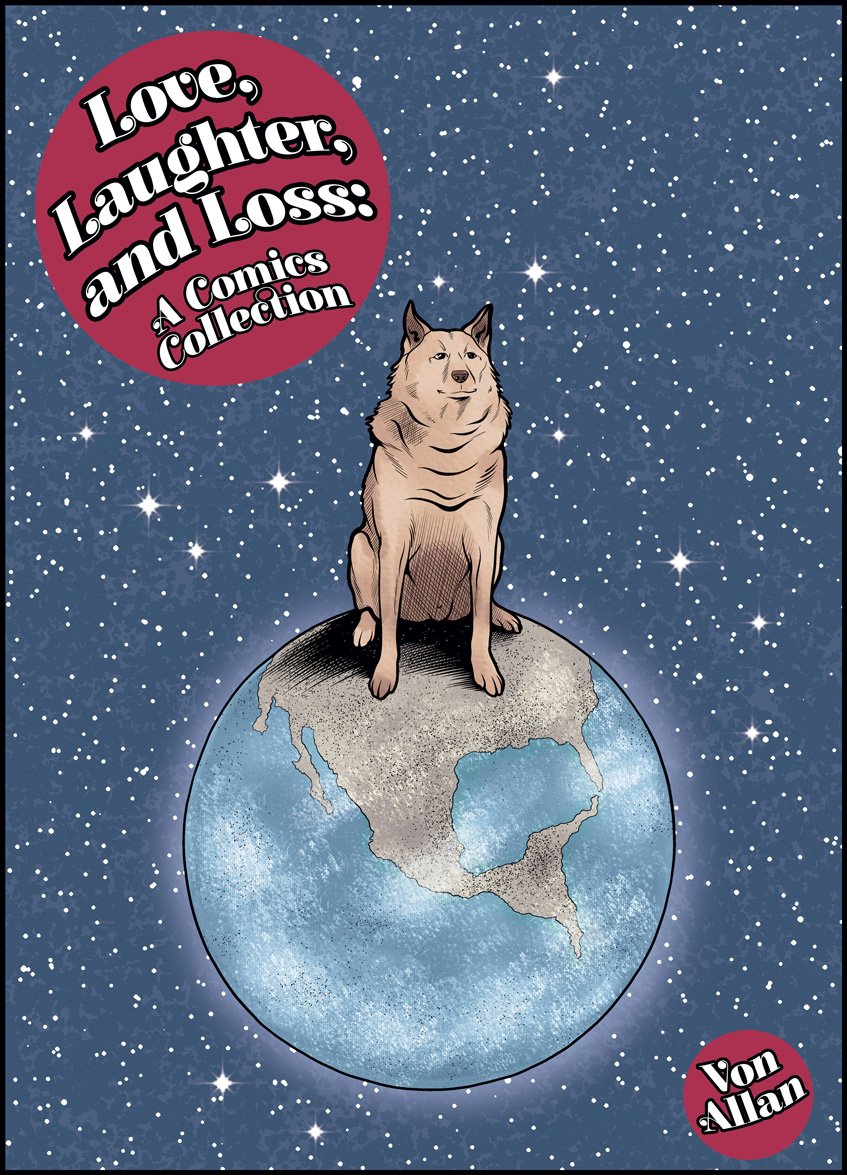
Canadian graphic novelist Von Allan (a pen name) persistently plays
with the tension between the mundane and the enchanted in his work, which is
usually self-published. In Love,
Laughter, and Loss, Allan funnels the enchanted and the emotionally
powerful through stories that emphasize the mundane, sometimes for humorous effect,
sometimes for tragic. In Wolf’s Head,
probably his best work to date, the fanciful elements of a science fiction tale
are masterfully pulled into a grounded, emotionally realistic story about a
child grappling with their mother’s legacy. As Allan has moved into nonfiction
(both in his public writings for the Ottawa
Citizen and in participating in the documentary I Am Still Your Child), he continues to pull us deeper into the
everyday, hoping to find the meaningful, and the tragic, therein.
 In Love, Laughter, and Loss,
Allan works through two modes of storytelling. In the first half of the book,
he inverts our expectations of fantasy storytelling. Traditionally, we have
read high fantasy like the Lord of the
Rings and then seen those gorgeous fantasy worlds translated, often
unsuccessfully, into the tropes and tricks of roleplaying games. The
“halflings” in Dungeons and Dragons
are a way to recreate the Hobbits in Lord
of the Rings without violating copyright; role playing games are like a
strainer, sucking the depth and elegance from high fantasy so that it can be
brought to a table with dice and miniatures.
In Love, Laughter, and Loss,
Allan works through two modes of storytelling. In the first half of the book,
he inverts our expectations of fantasy storytelling. Traditionally, we have
read high fantasy like the Lord of the
Rings and then seen those gorgeous fantasy worlds translated, often
unsuccessfully, into the tropes and tricks of roleplaying games. The
“halflings” in Dungeons and Dragons
are a way to recreate the Hobbits in Lord
of the Rings without violating copyright; role playing games are like a
strainer, sucking the depth and elegance from high fantasy so that it can be
brought to a table with dice and miniatures.
In his stories, such as “The Cowardly Clerics of Rigel V,” Total
Party Kill,” and “The Two Magic-Users,” Allan tells us stories that begin with
mundanity of role playing games. What would, in high fantasy, be the story of
two wizards becomes the story of “two magic users.” In starting from the
limitations of the tabletop roleplaying game, Allan makes us chuckle at the deflation
of the genre.
That same tendency (to start with the mundane) also undergirds Von
Allan’s attempts to show us tragedy in Love,
Laughter, and Loss. In a story about the Voyager and Pioneer spacecraft
(“When I Find You Again, It Will Be In Mountains”), Allan begins with a simple
dream of lost love. It’s only at the end of the dream that we see that the
dreamers are actually spacecraft. Similarly, “I Was Afraid For My Life” begins
as a story about a boy and a dog, only in the last pages revealing its powerful
statement on race, violence, and policing.
In all of these works, Von Allan’s commitment to pulling the
fantastic and the tragic into the everyday makes it easier for him to tell a
story that creates a laugh or packs a punch.
 Wolf’s Head is a stronger work than the bits and pieces
collected in Love, Laughter, Loss,
and so deserves a closer look. Wolf’s
Head begins, in a way, where “I Was Afraid For My Life” leaves off, and its
introductory page is remarkable in that it uses texture to convey the energy of
the moment. The figure in the foreground is angry, and the play of texture
behind her propels her forward. The lines radiating from something like an
explosion of color represent, in texture, what she is feeling inside: Lauren
Greene’s anger is propelled by the structural racism and violence inherent in
policing, especially after the events of 2020 in Minneapolis. Her conscience
won’t abide her participation in that system, and so she quits.
Wolf’s Head is a stronger work than the bits and pieces
collected in Love, Laughter, Loss,
and so deserves a closer look. Wolf’s
Head begins, in a way, where “I Was Afraid For My Life” leaves off, and its
introductory page is remarkable in that it uses texture to convey the energy of
the moment. The figure in the foreground is angry, and the play of texture
behind her propels her forward. The lines radiating from something like an
explosion of color represent, in texture, what she is feeling inside: Lauren
Greene’s anger is propelled by the structural racism and violence inherent in
policing, especially after the events of 2020 in Minneapolis. Her conscience
won’t abide her participation in that system, and so she quits.
I love this panel because it really shows the nuanced ways that Allan
uses both the extraordinary and the simple to communicate. In a longer work
like Wolf’s Head, the interplay
between the fantastic dimensions of his stories and the tiny details of life in
his art are what makes his voice unique in contemporary comics.
 When Lauren finds a new job, Allan deploys those same texture
techniques (crosshatching and some computerized spotting) to create a muddy
picture of the place where Lauren now works. Instead of being propelled forward,
Lauren is caught in the muck and darkness of her new life.
When Lauren finds a new job, Allan deploys those same texture
techniques (crosshatching and some computerized spotting) to create a muddy
picture of the place where Lauren now works. Instead of being propelled forward,
Lauren is caught in the muck and darkness of her new life.
Allan introduces us to Lauren’s mom with the same techniques. I
absolutely adore this first image of her mom (all solid colors and dark, thick
lines), in sharp relief against (again) the complex textures of the apartment
hallway and doorframe. On first, quick read, it’s possible to miss the oddly
shaped musical note coming from her bag.
 That “bag” is the touch of the extraordinary in the Wolf’s Head story. Lauren’s mom works as
a janitor in a research & development firm (Advanced Research Projects
Corporation). The singing shoulder bag is actually a shapeshifting machine, an
ARPC invention that has achieved self-awareness. It protected Lauren’s mom from
an explosion at the factory and becomes her companion and guardian. When Lauren
learns about her mom’s self-aware machine (and the goons from ARPC who want it
back), she and her mom get into a fight about what to do next. Their reunion is
possibly the most touching moment in the book. The goons kidnap Lauren to get
at her mom. While Lauren’s mom is interrogated, she passes away from a heart
attack, and Lauren is left with the self-aware machine and the ARPC goons in
hot pursuit. The machine protector steps up and saves Lauren from the ARPC.
That “bag” is the touch of the extraordinary in the Wolf’s Head story. Lauren’s mom works as
a janitor in a research & development firm (Advanced Research Projects
Corporation). The singing shoulder bag is actually a shapeshifting machine, an
ARPC invention that has achieved self-awareness. It protected Lauren’s mom from
an explosion at the factory and becomes her companion and guardian. When Lauren
learns about her mom’s self-aware machine (and the goons from ARPC who want it
back), she and her mom get into a fight about what to do next. Their reunion is
possibly the most touching moment in the book. The goons kidnap Lauren to get
at her mom. While Lauren’s mom is interrogated, she passes away from a heart
attack, and Lauren is left with the self-aware machine and the ARPC goons in
hot pursuit. The machine protector steps up and saves Lauren from the ARPC.
Wolf’s Head is at its best in the small things – Lauren’s search for meaning
after leaving the force, her reunion with her mother. The story of the
self-aware machine is the tiny twist that helps bring Von Allan’s gift for
bringing the everyday into view. It’s difficult not to read this touching,
loving mother-daughter relationship in Wolf’s
Head without a sense of Von Allan’s interest in mental illness in families.
His 2009 work, the road to god knows,
is no longer in print, but the narrative arc (of a mom separated her from her
child) resonates.
In the road to god knows, the
separation between child and parent is more painful than the separation in Wolf’s
Head. In the latter, Lauren’s mom finds and comes to care for a sentient
machine – anything, including reconciliation with Lauren, is possible in such a
story. In the road to god knows, parent
and child are ruptured by an illness that cannot be removed, only struggled
with.
In an interview with the CBC after Allan won recognition as a
“trailblazer,” we learn that his late mother had schizophrenia; in other of his
writings, he has addressed mental illness. In interview and essay, Von Allan’s
penchant for crafting a picture of a realistic world helps him communicate the
complexities of living with mental illness. In his writings for the Ottawa Citizen, Allan (writing under his
real name as Eric Julien) shares his relationship with his childhood friend,David Thomas Foohey. Allan lays the facts of Foohey’s life on the table for the
reader: his struggles living with older, blind parents who divorced; his
struggles losing those parents (in 2004 and 2008). His depictions of Foohey’s
attempt to grapple with mental illness are straightforward:
In Dave’s case, the medication emotionally
“flat-lined” him. He phrased it this way: all of his emotions, not just the sad
ones, were shunted off. Not sad, not filled with loss, but equally missing out
on happiness and joy. There was just nothing at all. As a result, Dave gave up
on the medication. He never did try another.
No hyperbole, no drama – whatever emotion you draw from Foohey’s
story, you draw from the straightforward presentation of Dave’s story.
Allan knows that his power as a storyteller comes from letting the
everyday speak its own power, whether in the short stories of Love, Laughter, Loss, in the longer
works (the road to god knows and Wolf’s Head), or nonfiction essays like
“Dave’s Story.” Across his diverse works, by placing his focus on the everyday,
Allan makes me laugh, makes me sad, and gives me hope.
References
Von Allan Studio website: https://www.vonallan.com/
“Julien: Dave's Story — and the Agonizing Dilemma of Mental Illness.”
Ottawa Citizen July 4, 2022
Love, Laughter, Loss. Ottawa: V. Allan Studio, 2021.
the road to god knows. Ottawa: V. Allan Studio, 2009.
Wolf’s Head. Ottawa: V. Allan Studio, 2021.
“Trailblazers: Eric Julien.” CBC
Interactive. March 23, 2019
I Am Still Your Child. CatBird Productions 2017