Articles from and news about the premier and longest-running academic journal devoted to all aspects of cartooning and comics -- the International Journal of Comic Art (ISSN 1531-6793) published and edited by John Lent.

Showing posts with label NBM. Show all posts

Tuesday, December 23, 2025

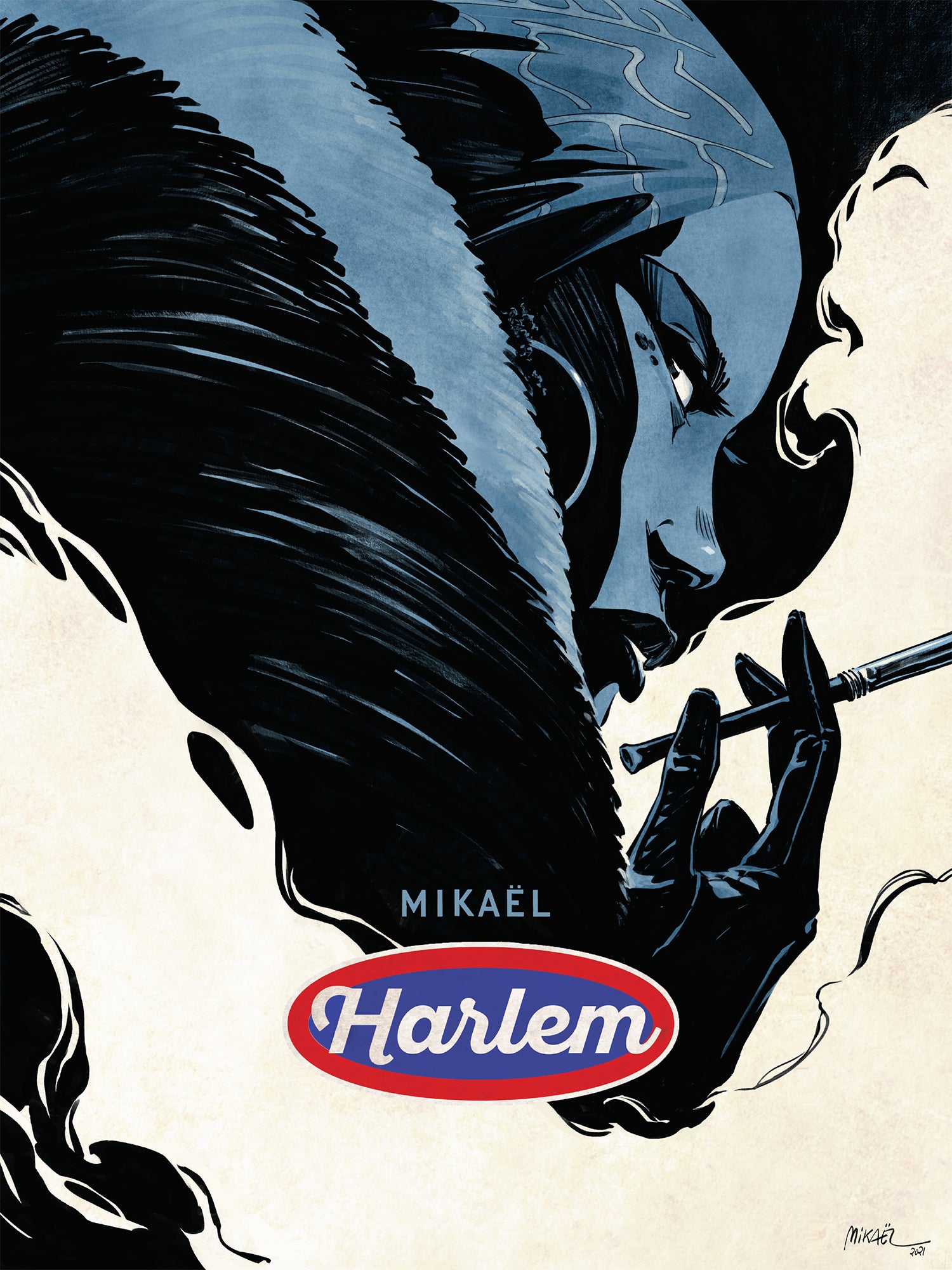
Graphic Novel Review: Harlem by Mikaël

 Harlem

 reviewed by Matthew Teutsch, Associate Professor of English, Piedmont University

Mikaël. Harlem. New York: NBM Graphic Novels, 2024. https://nbmpub.com/products/harlem


French-Canadian artist Mikaël concludes his New York triptych with Harlem, a fictionalized narrative about Stephanie St. Clair, a woman from Guadalupe who became a businesswoman and racketeer in Harlem during the early part of the twentieth century and the Harlem Renaissance. The narrative moves back and forth in time, detailing St. Clair’s life in Guadalupe to 1930s Harlem. When depicting St. Clair’s early life and eventual immigration to the United States, Mikaël’s color palette changes from more browns and darker colors to shades of purple with splashes of yellow. The yellow, which appears in various objects during these flashbacks from a parakeet to a bag to a light in a window, displays St. Clair’s hope and the hope of others for a better life, one where they can live their lives in happiness and safety.    

While on the surface Harlem appears to be a crime narrative centered on St. Clair, Mikaël infuses his story with much more. Mikaël highlights the ways that St. Clair and others navigate, through extra-legal means, a system that keeps them oppressed and subjugated from the highest levels of city government to the police force that walks the streets to other racketeers, notably Dutch Schultz (a white man), who also participates in extra-legal activities. Along with all of this, the community must deal with the ramifications of the Great Depression on their lives. Even as she maintains a hard exterior, St. Clair looks out for the community, providing individuals with hope and resistance, specifically through the pieces that she writes in the New York Amsterdam News calling out systemic oppression.

Ostensibly, the white reporter Robert Bishop serves as the overarching narrator of Harlem, opening the narrative by telling us, “What I did was unforgivable. I know.” By framing the narrative through Bishop, Mikaël allows us an outside view of events. The reader does move into St. Clair’s perspective and the perspectives of others, but Bishop remains the core, and in this manner, he serves, in many ways, like the “white clientele” who flock to Harlem for the clubs and nightlife that Harlem’s residents are barred from entry. Bishop has a relationship with Tillie Douglas, one of St. Clair’s friends, and their interactions highlight the ways that white supremacy did not solely reside within the Jim Crow South or the once colonial regions of the Americas. 

Bishop’s connection to St. Clair arises after the editor of the New York Amsterdam News tells her she needs to revise a piece that she hopes to get published in the paper. St. Clair sees Bishop with Douglas and enlists him to help her revise the piece, which he does. In her article, St. Clair lays out what she and the community endure in the face of white supremacy. Over three pages, Mikaël prints St. Clair’s article interspersed with images of individuals getting kicked out of their homes, police brutality, and cultural tourism with whites descending on Harlem for clubs. The sequence ends with the reactions to her piece from Schultz, the police, and her right-hand-man Bumpy. Thematically, this three-page sequence sums up Harlem and the ways that St. Clair pushed back against a system that seeks to keep her and other locked in cages as they bloody their wings against the iron bars.

In “Sympathy,” Paul Laurence Dunbar uses the metaphor of a caged bird beating its wings until “its blood is red on the cruel bars” to describe his position as a Black man at the turn of the twentieth century in America. He concludes the poem with the famous line, “I know why the caged bird sings!” The caged bird metaphor appears throughout Harlem, from St. Clair releasing a bird from a cage in Model’s shop to numerous panels depicting birds flying as St. Clair and others walk the Harlem streets. Harlem concludes with St. Clair returning to the community as residents thank her for speaking in front of the commission and her actions, and the final two panels show birds flying freely in the sky. The first shows birds flying up into the air as we see buildings and a street sign for 125th street. The final panel zooms out, showing the entire New York skyline with flocks of birds in the distance, symbolizing St. Clair’s and the residents’ desire to, as St. Clair tells W.E.B. Du Bois earlier, that she will not “shut [herself] between four walls.”  

If one reads Harlem quickly, one will miss many of the historical and cultural references that Mikaël incorporates throughout the book. For example, in a seven-panel sequence following a numbers runner, we see the marquee for Smalls Paradise, one of the only African-American owned clubs in Harlem at the time, and a panel depicting young kids marching with brooms and paper hats imitating the Harlem Hellfighters as a World War I veteran sits on the side. Mikaël also incorporates two poems by Langston Hughes, one at the end of each section. Hughes’ “Harlem” concludes section one, and Hughes’ repetition, in the first and third stanzas of referring to Harlem as “on the edge of hell” drives home what St. Clair fights against. Juxtaposed against “Harlem,” Mikaël ends the book with Hughes’ “I, Too,” where Hughes proclaims his equality and finishes by stating, “I, too, am America.”

Mikaël ‘s Harlem details the history of white supremacy in the United States, colonialism, sexism, and structural issues that impact Harlem and its citizens. It also highlights community and the ideals of America, specifically the immigrant experience and the ways that communities work together to confront oppression and move forward. Through Bishop, Mikaël explores allyship and the need for white individuals like Bishop to listen instead of speaking at times. Bishop gets St. Clair arrested, and as she leaves prison, we see Bishop’s words to her as he types them. He tells her when he envisions her in his mind he sees “[a] look of anger. The anger of an entire people,” and he concludes by telling her, “I only wanted to speak out about the world around me because I thought I had the right to.” Bishop’s words end, allowing St. Clair a voice for herself at the end, a voice that speaks for Harlem.     

 A version of this review will appear in IJOCA 27-2  

Wednesday, September 24, 2025

Graphic Novel Review: Surrounded: America’s First School for Black Girls, 1832

 reviewed by John Craig


Wilfrid Lupano and Stéphane Fert. Surrounded:  America’s First School for Black Girls, 1832. New York:  NBM Publishing, 2025. 144 pp. US $24.99 (Hardcover). ISBN:  978-1-6811-2348-6. https://nbmpub.com/products/surrounded

Wilfrid Lupano’s Surrounded, illustrated by Stéphane Fert, is a graphic novel that explores themes of resistance, education, and racial injustice in the antebellum United States. The story is centered on the Canterbury Female Boarding School, the first school for Black girls in America, founded in 1832 by abolitionist, Prudence Crandall. The visual storytelling plays a crucial role in shaping the narrative, and the artwork enhances the story’s emotional weight. Fert’s distinctive and unconventional color palette adds depth to the storytelling, though the distinction between Black and White characters could have been more pronounced. The Black characters are depicted in light brown tones, whereas the White characters are rendered in a blend of purple and dark pink hues. While visually intriguing, a stronger contrast might have provided additional clarity in representation. One of the most notable elements of the graphic novel is its opening, which features an excerpt from The Confessions of Nat Turner by Thomas R. Gray. This choice immediately situates the graphic novel within the historical narrative of Black resistance. One of the key questions that arises while reading Surrounded is its intended audience. The themes and subject matter suggest it is unsuitable for young children, implying that it is aimed at middle school readers or older.

However, despite this assumed readership, the language remains relatively restrained. Given the graphic novel’s historical setting--the 1830s--it is surprising that it does not engage more directly with the racial terminology of the time. During this period, African-Americans would have most commonly been referred to as “Negro” or “Colored” rather than “Black.” Moreover, on Southern plantations, the n-word would have been prevalent. A bolder engagement with period-accurate language could have enhanced the graphic novel’s historical realism. Lupano also deliberately decides to forgo the use of “slave dialect” in the dialogue. While historically accurate dialect can add authenticity, it often risks reinforcing outdated stereotypes or becoming a distraction for readers. However, the graphic novel inconsistently incorporates elements of “slave vernacular” in certain moments, while predominantly using modern language. This inconsistency raises questions about the graphic novel’s linguistic choices--Lupano might have benefited from either fully committing to historical dialect or exclusively using modern language for accessibility.

The book’s depiction of anti-abolitionist sentiment in Connecticut is historically accurate and highlights an often-overlooked reality. While Boston was a major center of abolitionist activity, New England was not uniformly abolitionist. Many White Northerners, including those in Connecticut, were indifferent to, or actively resisted, Black liberation despite the presence of vocal abolitionist movements. However, strong opposition to abolition existed even in Northern states, making the graphic novel’s choice to highlight Connecticut’s resistance an important and accurate representation of the complexities of the time. Although the graphic novel successfully portrays the dangers faced by Black Americans in the antebellum North, it overlooks several key aspects of African-American resistance and survival during this period. Plantation owners in the South were deeply fearful of slave rebellions and conspiracies, and Nat Turner’s rebellion was only one of many uprisings that occurred. The graphic novel does not address the broader landscape of resistance, such as:


  • The New York Slave Revolt of 1712
  • The Denmark Vesey Plot of 1822
  • David Walker’s Appeal in 1829
  • The Amistad slave ship rebellion in 1839
  • The Creole slave mutiny of 1841
  • The role of Maroon communities--escaped Africans who established independent settlements throughout the South and the Caribbean.


Additionally, the graphic novel does not acknowledge the impact of the “Fugitive Slave Act of 1793,” which allowed enslavers to capture fugitives across state lines, making life in the North perilous for free and escaped Black individuals. Furthermore, Surrounded does not engage with the widespread influence of the Haitian Revolution (1791-1804), which profoundly shaped the fears of Southern enslavers and led to harsher restrictions on enslaved people in the U.S. Acknowledging these broader historical events could have provided a more nuanced and layered representation of the period.

As the graphic novel progresses, it exhibits patterns commonly seen in works by White creators depicting civil rights struggles or resistance during slavery. While Lupano’s intentions seem well-meaning, Surrounded risks centering whiteness in a narrative that should prioritize Black voices. The story increasingly shifts its focus to a White female teacher at the school, framing much of the narrative around the risks she takes rather than the agency of the Black girls she teaches. This structure echoes White savior narratives seen in films, such as “The Help” and “Dangerous Minds,” where Black struggles are filtered through the lens of White benevolence. From an Afrocentric perspective, the graphic novel misses an opportunity to present Black people as the primary agents of their own liberation. The theory of Afrocentricity, developed by Molefi Kete Asante, emphasizes the importance of centering Black perspectives and highlighting Black agency in historical narratives. Black individuals in the antebellum period actively sought education and devised ways to protect themselves from the dangers of White supremacy. Instead of fully exploring these dynamics, Surrounded leans too heavily on the perspective of its White protagonist, sidelining the Black women who should be at the center of this story.

Another significant omission in Surrounded is the presence of Black men. While the graphic novel depicts White men in heroic roles, protecting Black women and the school, there is a noticeable absence of Black men in these positions. Given the historical realities of the time, this absence raises questions about whether the graphic novel unintentionally reproduces stereotypes about Black male disengagement from the struggles of Black women. Historically, Black men actively participated in educational initiatives, abolitionist movements, and the broader fight for Black freedom. Their exclusion from the narrative suggests a missed opportunity to provide a more holistic representation of Black community resistance.

Certain character choices in the graphic novel also reflect familiar tropes found in narratives about the Black struggle. One such example is a Black male character who appears to embody internalized anti-Blackness. While it is true that some Black individuals internalized racist ideologies, his presence in the story feels more like a recurring archetype in White-authored narratives than a fully developed character. His eventual death reinforces an all-too-common trope in which such characters are included only to meet a tragic end. What this character contributes to the larger narrative is unclear beyond fulfilling a predictable storytelling pattern.

Additionally, the depiction of a divine Black female figure is both compelling and problematic. The moment in which a student envisions God as a woman of color is powerful in its subversion of Eurocentric religious imagery. However, the decision to depict her as nude is an odd and unnecessary creative choice. While artistic depictions of divine figures often engage with themes of vulnerability and purity, in this context, it raises concerns about the exoticization of Black women’s bodies.

Surrounded is an engaging graphic novel with a unique artistic style and compelling subject matter. The visual elements enhance the storytelling, adding emotional depth to key moments. The graphic novel succeeds in highlighting the hostility Black-Americans faced--even in the North--and brings attention to an important, often overlooked part of history. However, it also falls into several common pitfalls that often appear in White-authored stories about Black resistance. The overemphasis on White characters, the sidelining of Black women’s agency, and the exclusion of Black men all weaken its impact as a story about Black liberation. That said, Surrounded is a valuable contribution to historical fiction, as it brings attention to an important chapter in Black history. Stories like this play a crucial role in sparking conversations about history, representation, and the ongoing need to center Black voices in narratives of Black liberation.